The Deep Space Network:
Hearing a Whisper from 25 Billion km Away
Voyager 1 transmits on about 22 watts, and its signal reaches Earth at around 10⁻¹⁸ W. Three complexes 120° apart, 70 m dishes and antenna arraying are why we can still hear it.
Around mid-November 2026, Voyager 1 will for the first time be one full light-day from Earth, about 25.9 billion km. From then on, a "good morning" sent from the ground takes a whole day to reach the spacecraft, and the reply takes another day to come back. Launched in 1977, the probe was already about 25.8 billion km away as of October 2026, and contact with it has never truly been lost. The link is carried by NASA's Deep Space Network (DSN), which handles every command sent to Voyager and every bit of data it returns.
A Wildly Lopsided Link
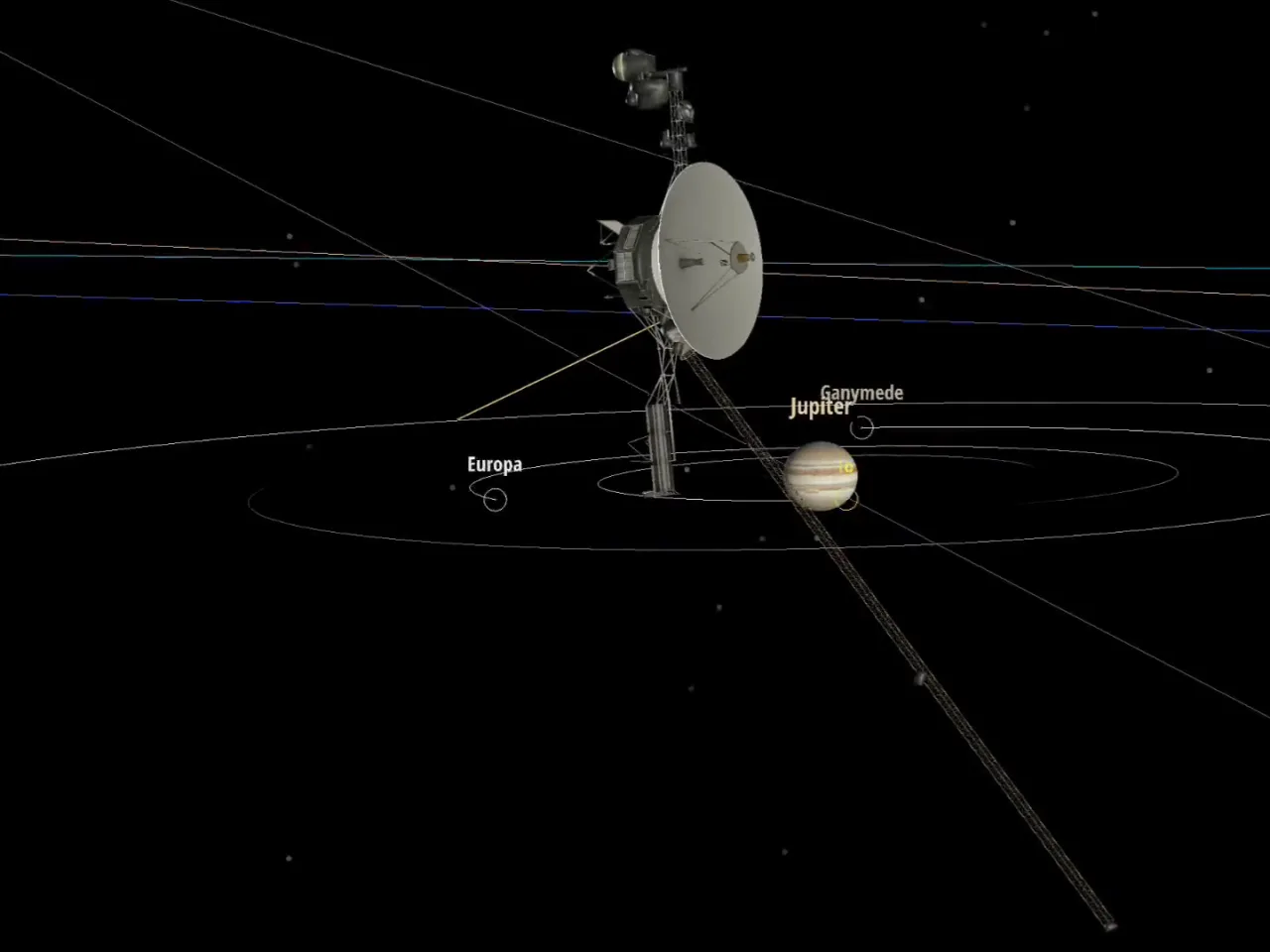
Voyager 1 talks through a 3.7-meter high-gain dish driven by a transmitter of about 22 watts, roughly the bulb in a refrigerator, downlinking in X-band near 8.4 GHz. Once the radio wave leaves the antenna it spreads out, and its power density falls with the square of distance: ten times farther means one hundredth of the power. What arrives at Earth is on the order of 10⁻¹⁸ W or less, a figure JPL has quoted for years when describing Voyager tracking.
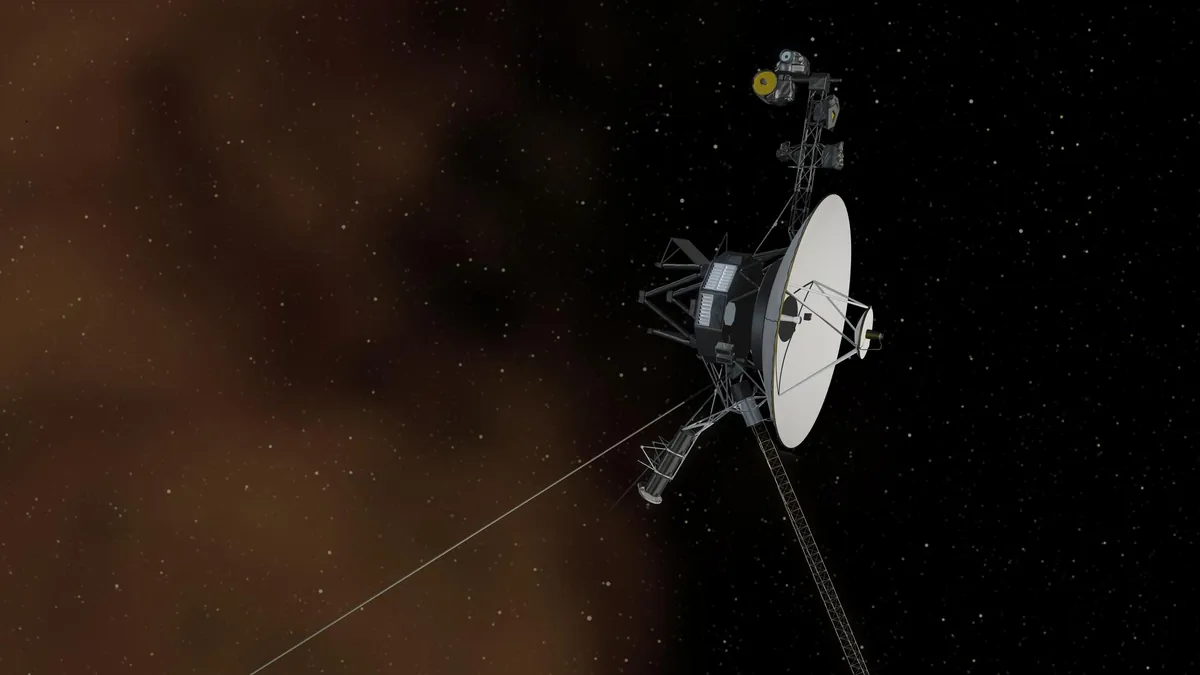
That is far below the thermal noise of ordinary electronics. There are only two ways to pull such a signal out of the noise: make the collecting area very large, and drive the noise very low. The DSN is essentially those two ideas turned into engineering.
Three Complexes, About 120° Apart
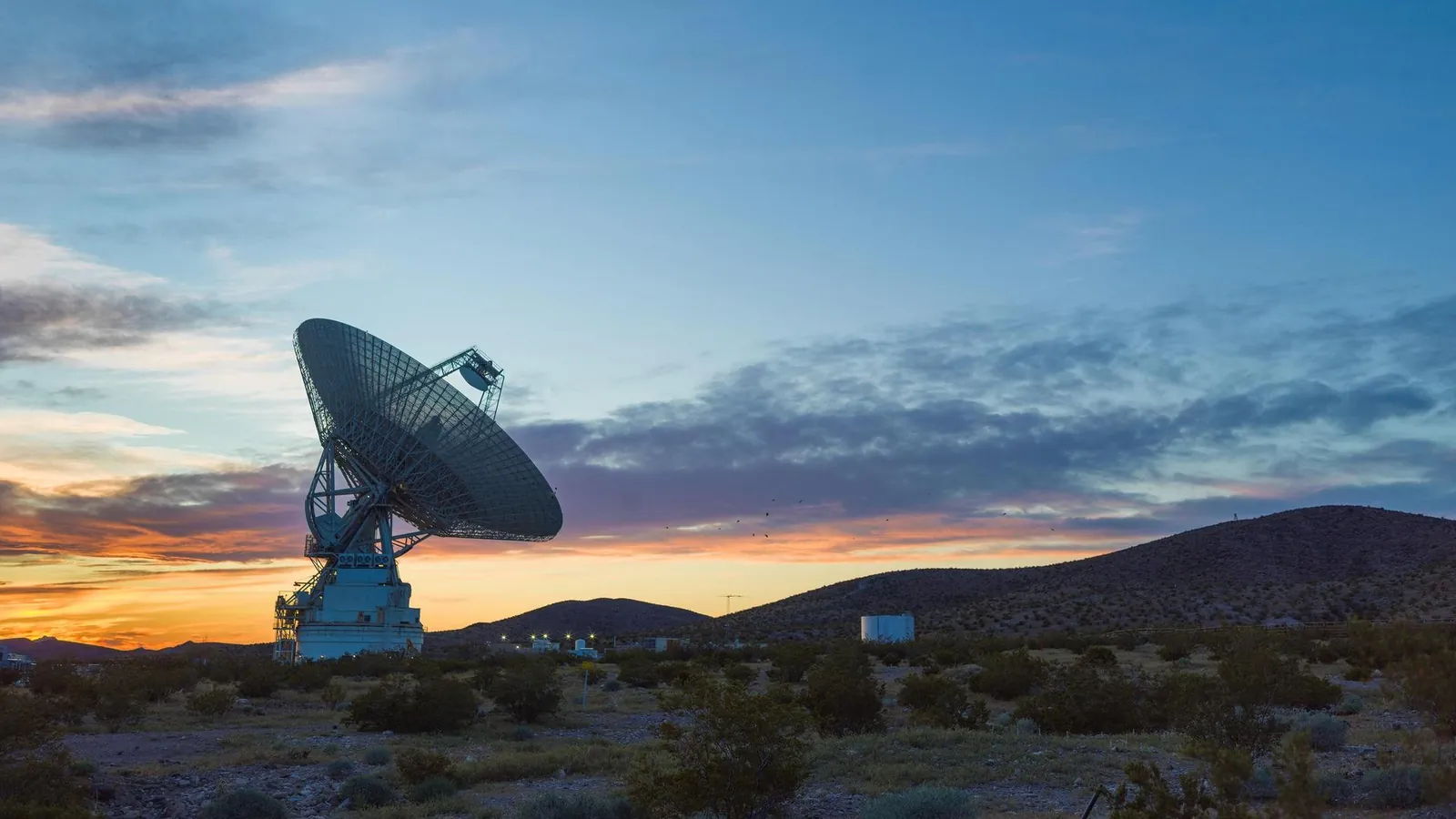
The DSN has three deep-space communication complexes: Goldstone in California, Madrid in Spain and Canberra in Australia, spaced roughly 120° apart in longitude. The layout exists to deal with Earth's rotation.
Any single site spends a large part of each day unable to see its target, because the target has set below the horizon. With three sites spread evenly around the globe, at least one can always see the spacecraft, and as one station is about to lose it, the next has already picked it up. For missions tracked continuously for decades, that relay is the precondition for staying in contact. JPL operates the network, which serves dozens of deep-space missions at once.
Geometry also sets limits. After its Neptune flyby, Voyager 2 headed south of the plane of the planets, and the only antenna that can send it commands is the 70-meter dish at Canberra.
70-Meter Dishes, Arraying and Noise
Each complex is built around a 70-meter (230-foot) parabolic antenna, plus several 34-meter beam-waveguide antennas. Received power scales with collecting area, so diameter matters. Goldstone's 70-meter dish, DSS-14, picked up signals from Mariner 4 in 1966, which earned it the nickname "Mars Antenna". It started out at 64 meters and was enlarged to 70 meters in 1988, precisely to catch Voyager 2's fainter signal at Neptune the following year.
Size alone is not enough. What counts in deep-space reception is the system noise temperature: the target signal is weaker than the noise, so any extra thermal noise buries it. DSN antennas therefore use low-noise amplifiers and cryogenically cooled receiver front ends, at sites chosen for quiet radio environments.
When one dish is not enough, antennas can be arrayed. The 70-meter and 34-meter dishes at a complex, or even dishes at different complexes, are combined coherently at the signal level to act like a single larger aperture. For Voyager 2's 1989 Neptune flyby, the DSN also teamed up with radio telescopes such as the Very Large Array in New Mexico. In April 2024, Madrid arrayed all six of its antennas on Voyager 1 for the first time. NASA noted that downlinking data from the probe's plasma wave instrument already required a five-antenna array, and that six would be needed as the distance grows.
Slow Is the Price of Distance
Voyager 1 currently returns science data at about 160 bits per second. That number falls straight out of the link budget. With received power on the order of 10⁻¹⁸ W, the only way to gain signal-to-noise is to lower the data rate and integrate longer, so data piles up over days and weeks.
For comparison, the James Webb Space Telescope, about 1.5 million km away, also downlinks through the DSN and, using Ka-band, reaches about 28 megabits per second. That is roughly five orders of magnitude faster than Voyager, and nearly the entire gap comes down to distance.
Faults and Power: Fragility Far from Home
Reliable does not mean infallible. Starting in November 2023, Voyager 1 sent back an unreadable, repeating pattern instead of data. Engineers traced it to a single failed memory chip in the flight data subsystem, which made about 3% of that computer's memory unusable. No single free region was large enough to hold the affected code, so the team split it into sections, moved them to different places and rewrote every reference to them. Engineering data returned in April 2024, and all four science instruments were back by June. The whole fix was done by uplinked commands, at a time when a signal took about 22.5 hours each way. Distance does not just weaken the signal, it also shrinks the room for handling a fault.
The other countdown is power. Both Voyagers run on radioisotope thermoelectric generators whose output drops by about 4 watts a year, so the team has been switching off instruments that still work. Voyager 1's cosmic ray subsystem was turned off in February 2025, and its low-energy charged particle instrument on April 17, 2026, leaving only the magnetometer and the plasma wave instrument collecting data. Engineers also devised a power-saving reshuffle nicknamed the "Big Bang", which swaps several old, power-hungry devices for lower-power alternatives all at once. Voyager 2 completed the swap in July 2026 and saved nearly 10 watts, and Voyager 1 then began testing the same procedure. How long this link of more than 25 billion km can last depends on careful trade-offs between power, instruments and time.
A Light-Day on the Ruler
Based on the ephemeris, around mid-November 2026 Voyager 1 will cross a symbolic threshold: one light-day from Earth, about 25.9 billion km. The number has no special physical meaning, but it is a mark on the ruler of human capability. A machine launched half a century ago now needs a full day for its signal to reach us, and we still receive it.
The DSN does more than receive signals. It extends our technical reach outward at the speed of light. The edge of exploration is often set not by how far we can fly, but by whether we can still hear.
To get a feel for the distance, select Voyager 1 in Solar Explorer: the info panel shows its distance from Earth in real time, and mission replay lets you retrace the routes of both Voyagers.