The Webb Telescope:
Why Go 1.5 Million km Away to See Infrared
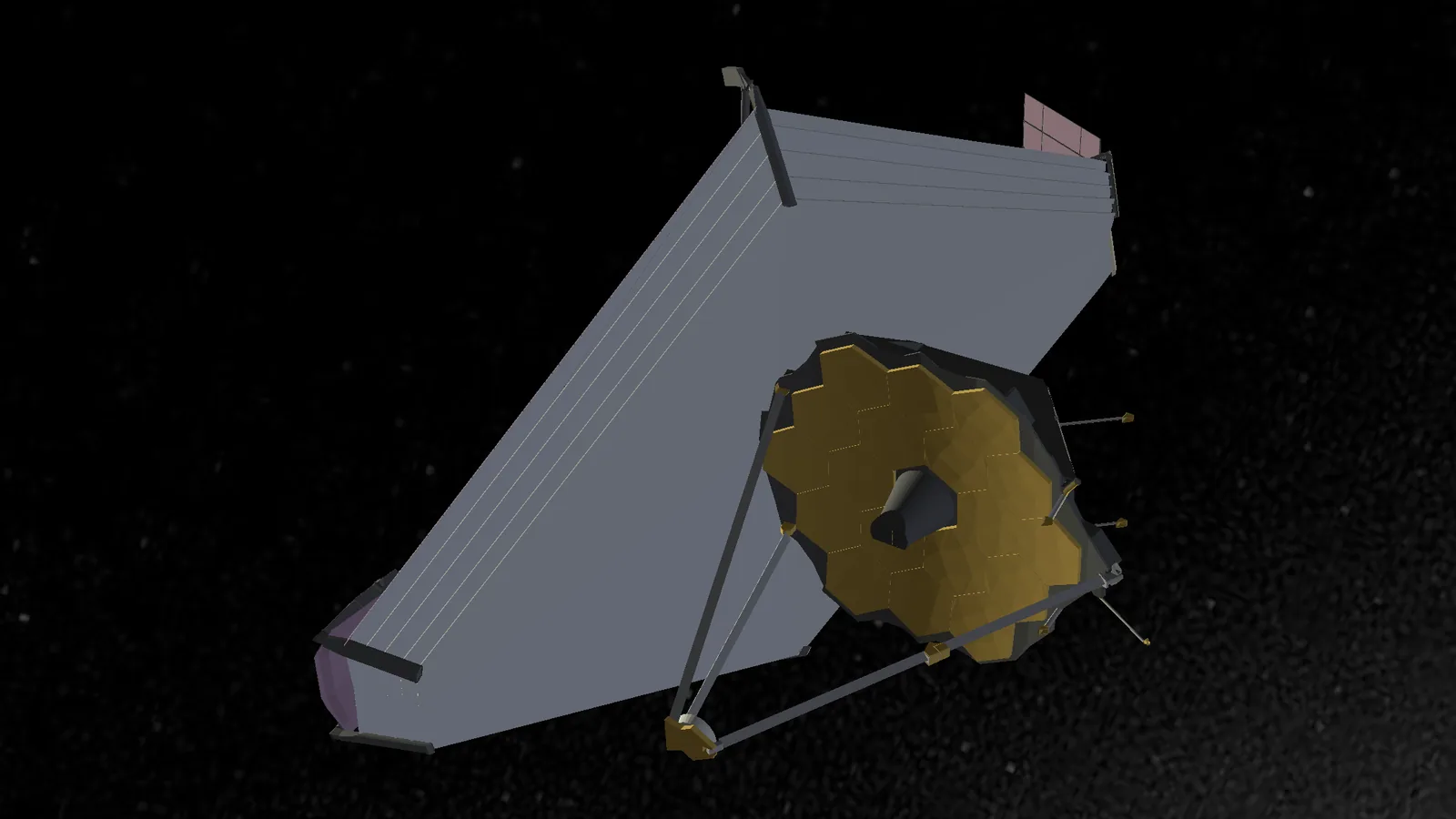
Cosmic expansion stretches the light of the earliest galaxies into the infrared. To see it, Webb carried a 6.5 m gold-coated mirror and a five-layer sunshield to Sun–Earth L2.
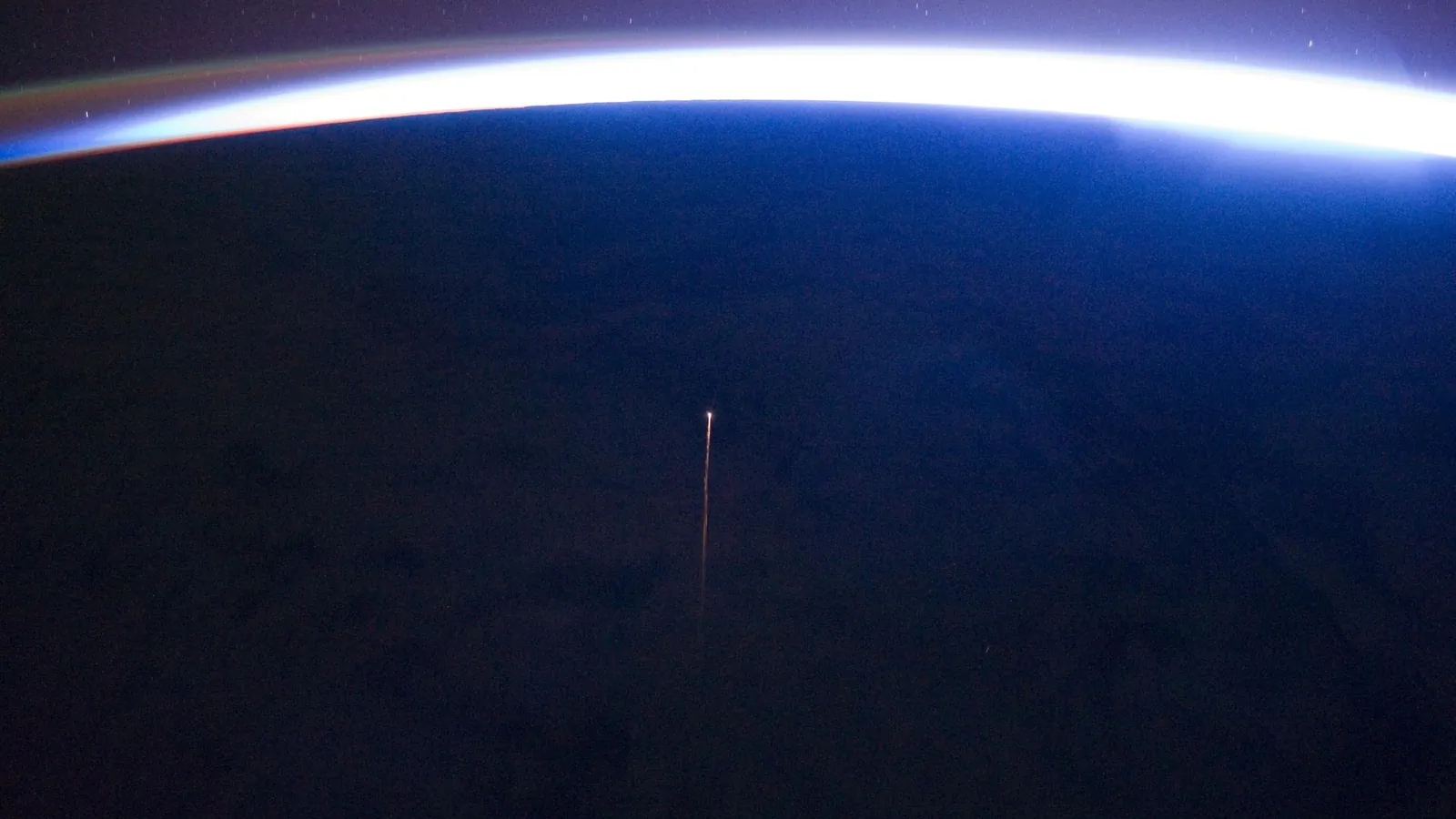
At 12:20 UTC on December 25, 2021, an Ariane 5 rocket lifted off from Europe's Spaceport in Kourou, French Guiana, carrying the James Webb Space Telescope (JWST). Its 6.5-meter primary mirror is made of 18 gold-coated hexagonal beryllium segments, and a five-layer sunshield about the size of a tennis court keeps the Sun's heat away. On January 24, 2022, it arrived near the second Sun–Earth Lagrange point (L2), about 1.5 million km from Earth. The telescope, a roughly 10-billion-dollar investment, does a very different job from Hubble.
Wavelength Defines the Mission
Webb is often described as a "bigger Hubble". It is bigger: Hubble's mirror is 2.4 meters across, Webb's is 6.5 meters, giving about six times the collecting area. But what really defines its mission is wavelength.
The universe is expanding. The farther away an object is, the more its light is stretched on the way to us. Visible light spans roughly 400 to 700 nanometers, and stretch it a dozen times or more and it lands in the infrared. This is cosmological redshift, and the redshift z is the stretch factor minus one, so z = 14 means the wavelength has been stretched 15 times. The light of the earliest galaxies has been pushed almost entirely into the infrared, so seeing them takes an infrared telescope.
On the ground that is close to impossible. Water vapor and carbon dioxide in the atmosphere absorb most infrared wavelengths, and a telescope that is not cold enough glows in the infrared with its own heat, drowning out faint signals.
Far Enough, and Cold Enough
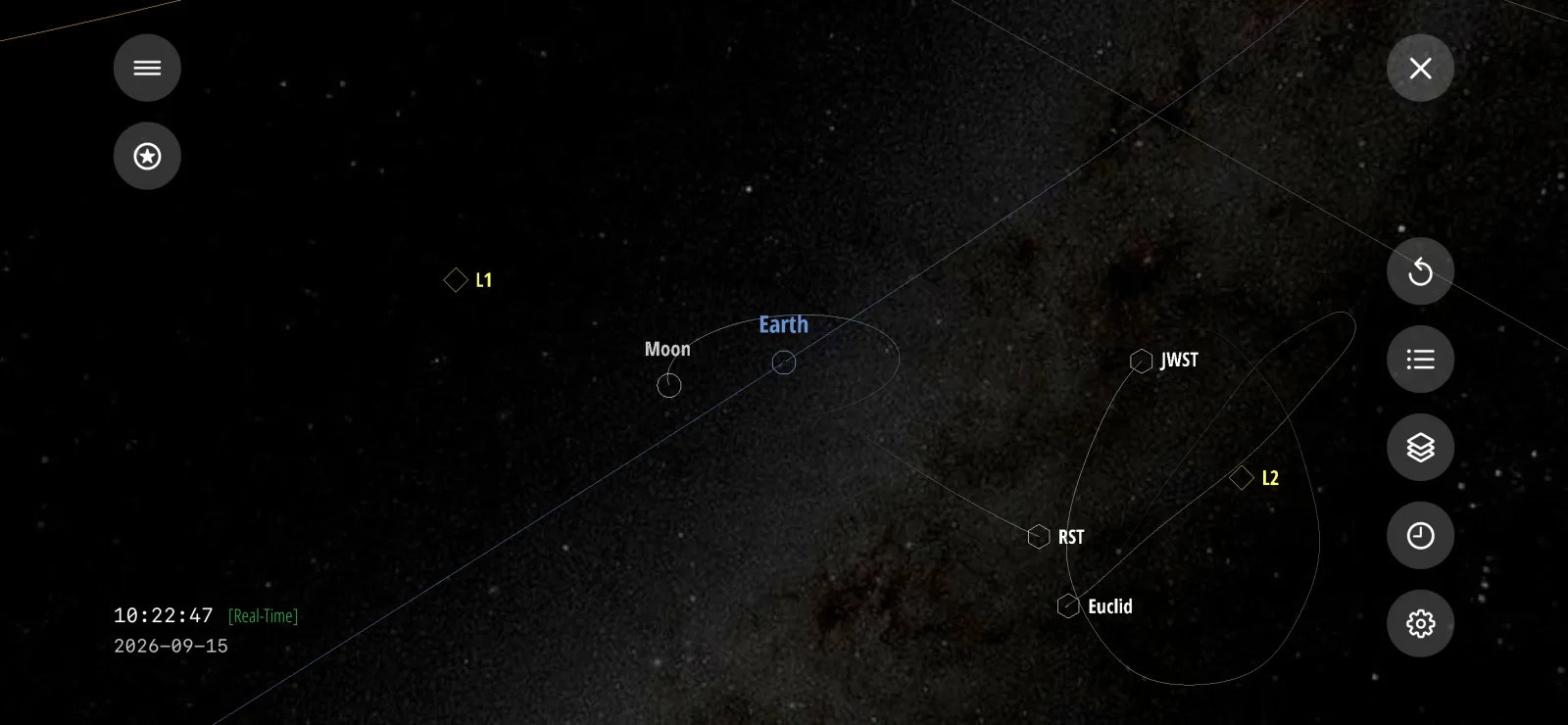
So Webb went to L2. In the Sun–Earth system, L2 lies on the side of Earth facing away from the Sun, about 1.5 million km out. A spacecraft there can follow Earth around the Sun in a fairly stable way, with the Sun, Earth and Moon always in roughly the same direction. That lets a single shield block all three heat sources at once. Strictly speaking, Webb does not sit at the L2 point itself. It travels around L2 on a large halo orbit.
The sunshield is the engineering centerpiece: five layers of polyimide film, unfurled to about 21 by 14 meters. The Sun-facing side runs at about 85°C, while the shaded side drops to about −233°C, a difference of more than 300°C across one machine. That thermal barrier keeps the optics and infrared detectors cold enough to collect faint infrared light quietly. The mid-infrared instrument, MIRI, also has its own cryocooler, which chills its detectors to about 7 K.
Webb observes from about 0.6 to 28 microns, from the near infrared into the mid infrared. That window holds the early universe, the birthplaces of stars and the chemical fingerprints of planetary atmospheres.
What It Has Delivered
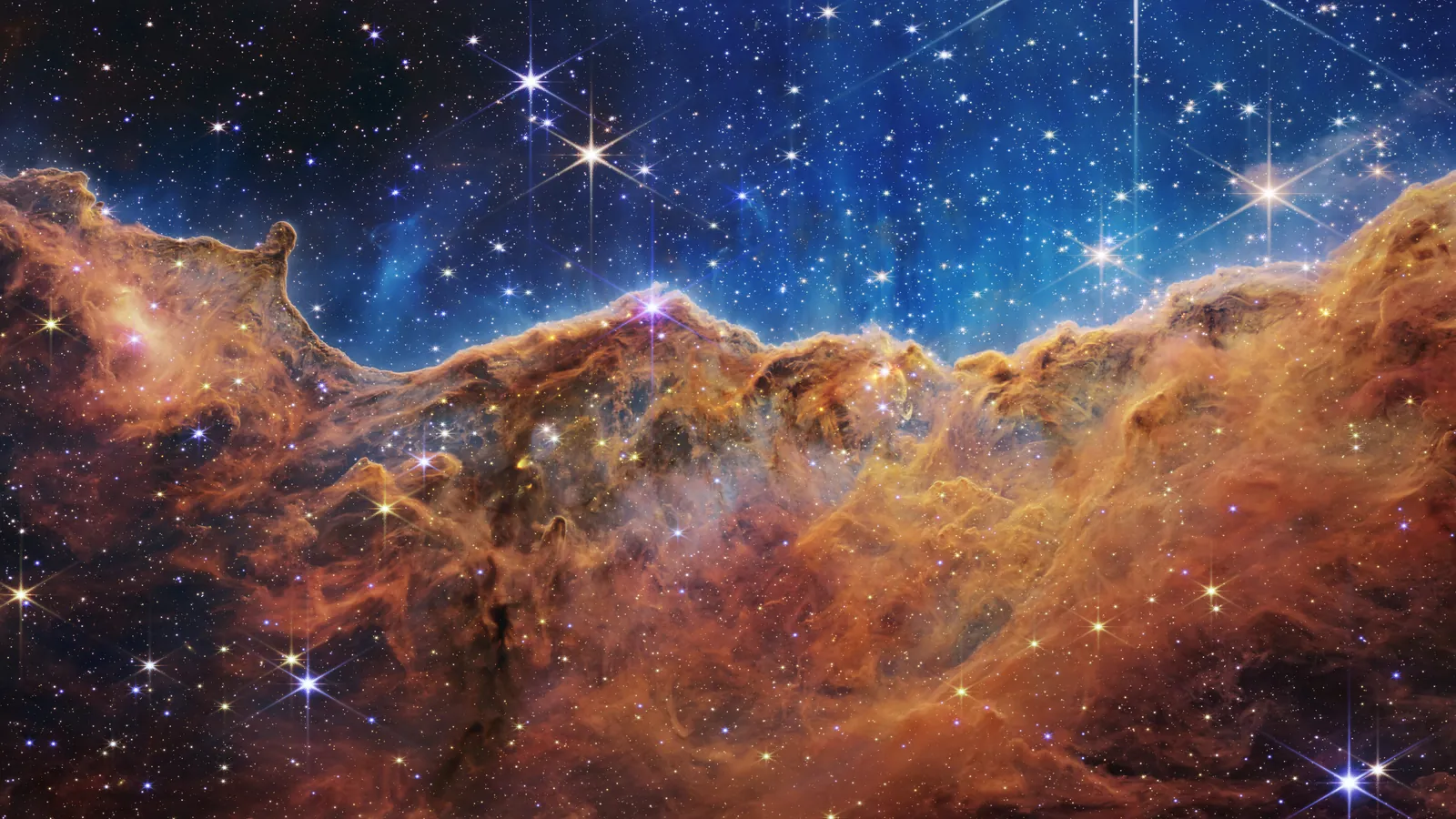
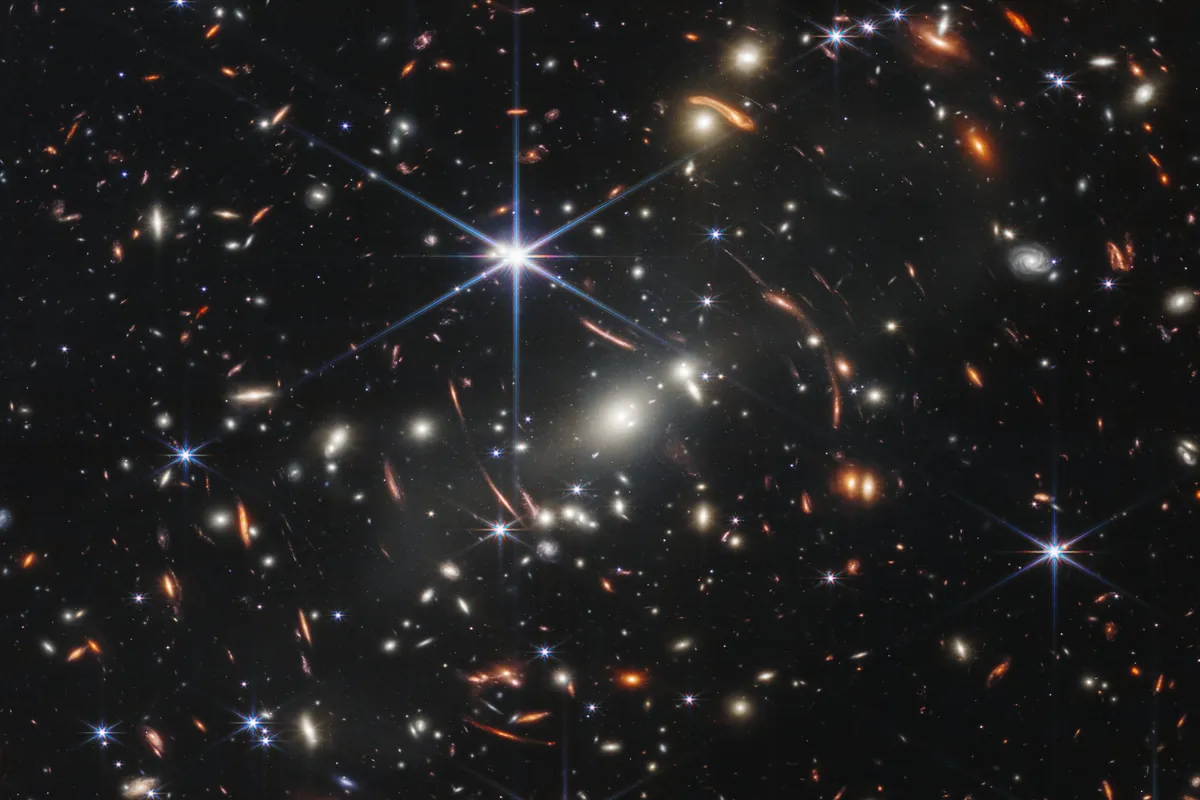
On July 11, 2022, Webb's deep field of the galaxy cluster SMACS 0723 was released first, showing thousands of galaxies, many too faint for Hubble. The following day the rest of the first science images came out, including the Cosmic Cliffs in the Carina Nebula, with star-forming regions shown in unprecedented detail.
For exoplanets, it did something that had been out of reach: reading the composition of a planet's atmosphere. In 2022, a team clearly detected carbon dioxide in the atmosphere of the gas giant WASP-39b, the first time that molecule had been confirmed in an exoplanet atmosphere. The method is simple in principle. As the planet passes in front of its star, starlight filters through its atmosphere, specific molecules absorb specific wavelengths, and gaps appear in the transmission spectrum. Where the gaps fall tells you which molecules are there.
Looking Far Is Looking Early
Light travels at a finite speed, so the farther you look, the earlier the universe you see. In May 2024, Webb astronomers announced the galaxy JADES-GS-z14-0 at a redshift of about 14.3 (later pinned down to 14.18 with the Atacama Large Millimeter/submillimeter Array), about 290 million years after the Big Bang. In May 2025 the record passed to MoM-z14: redshift 14.44, about 280 million years after the Big Bang. When its light set out, the universe was less than 300 million years old. As of October 2026, no spectroscopically confirmed galaxy lies farther away.
One detail is easy to miss. Because space is expanding, these objects are much farther away now than when they emitted their light, so "how long the light traveled" and "how far away it is today" are different numbers. MoM-z14's light has traveled for about 13.5 billion years, while the galaxy itself is now about 33.8 billion light-years away.
More striking still, these early galaxies already show carbon, nitrogen and oxygen, elements that can only be forged inside stars. So an earlier generation of stars must already have lived and died before them. We are still not seeing the universe's very first stars.
Not a Replacement but a New Window
Webb is constantly compared with Hubble, but the two divide the work rather than one succeeding the other. Hubble remains irreplaceable in visible and near-ultraviolet light, it was still operating as of October 2026, and the two telescopes frequently observe together.
Webb's real value is that it turned a band that was very hard to observe into a routine window on the sky. It did not overturn known physics, but it turned "the beginning of the universe" from theoretical reasoning into data that can be measured point by point. All of it started with a precision structure folded up for launch, flown 1.5 million km and unfolded layer by layer, with 18 mirror segments aligned to within nanometers.
In Solar Explorer, Webb is listed with the Lagrange-point spacecraft alongside Euclid and the Roman Space Telescope. All three fly near Sun–Earth L2, Webb follows its halo orbit around L2, and you can zoom in on its 3D model.