Atmospheric Reentry:
Why Capsules Don't Burn Up
At nearly 8 km/s, a capsule is heated less by friction than by air it compresses to over 10,000 K. A blunt shape, an ablative heat shield and a narrow corridor bring it home.
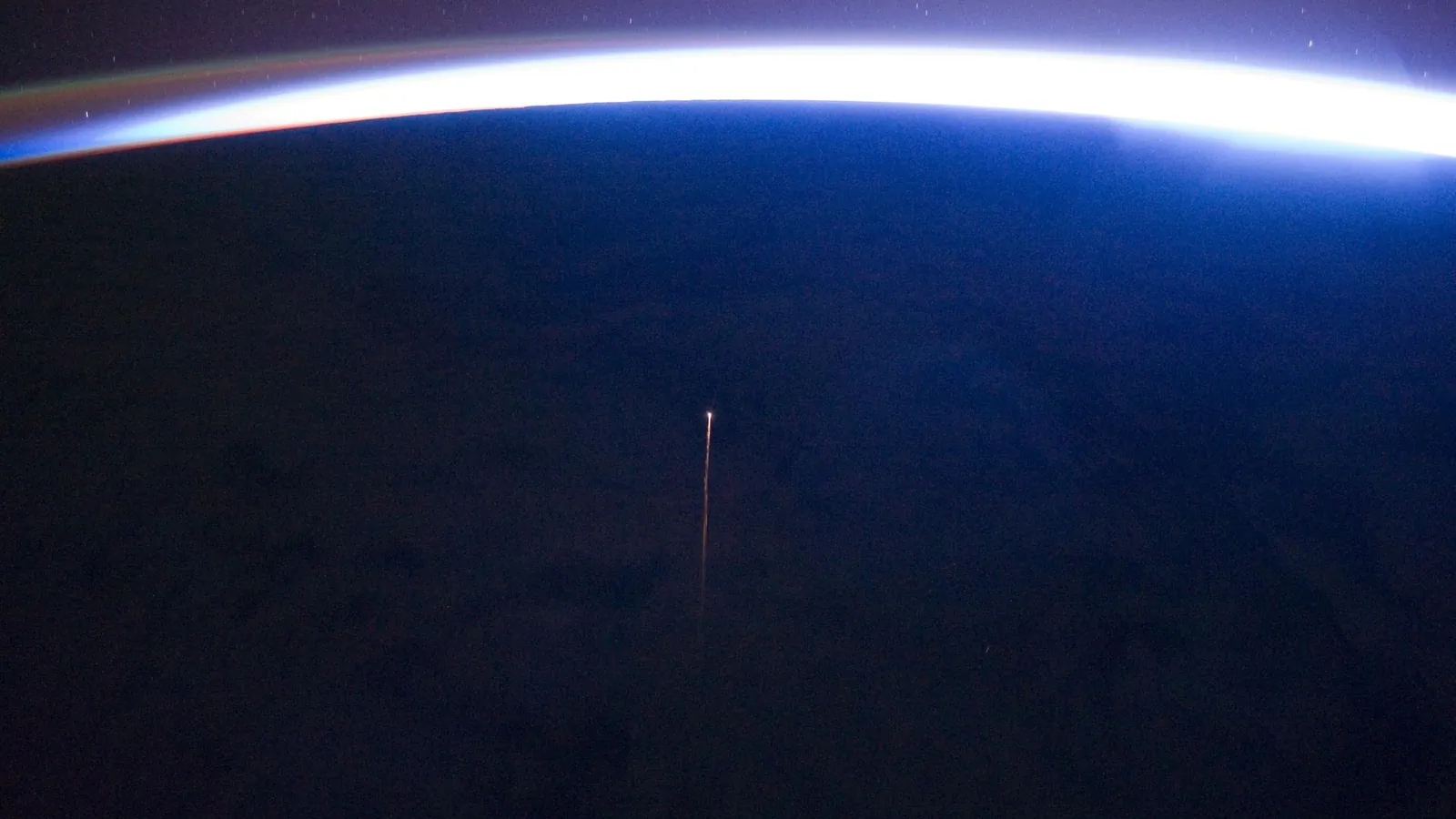
The most common explanation of reentry heating is friction. Friction does exist, but at nearly 8 km per second it is not the main source of heat. The real mechanism is compression. The air in front of the capsule has no time to get out of the way and is squeezed violently, and behind the shock wave the gas can exceed 10,000 K, far hotter than the roughly 5,800 K surface of the Sun. What the capsule feels is heat conducted inward through the boundary layer from that hot gas. It is not rubbing against the air, it is plowing down behind a layer of incandescent gas of its own making.
Start with the Energy Bill
Low Earth orbit speed is about 7.8 km per second. Kinetic energy per kilogram is ½v², which comes to about 30 megajoules. By the conventional TNT equivalent, a kilogram of TNT corresponds to about 4.2 MJ, so every kilogram of a returning capsule carries the energy of roughly 7 kilograms of TNT.
Braking to zero with rockets works on paper but not in practice. Take a hydrogen–oxygen engine with a vacuum specific impulse of about 450 seconds, an exhaust velocity of about 4.4 km per second. The rocket equation gives a mass ratio of about 5.9, which means about 83% of the starting mass would have to be propellant, before counting engines, tanks and structure, and all of that propellant would first have to be launched into orbit. So the atmosphere does the braking. Nearly all of the kinetic energy turns into heat, most of it handed to the surrounding air by the shock wave, and only a small fraction has to be absorbed by the capsule itself.
A Blunt Nose: The Counterintuitive Answer
Before intercontinental missiles and crewed spacecraft, the instinct for high-speed vehicles was that sharper is better: a pointed nose has less drag and "pierces" the air. Around 1951 and 1952, H. Julian Allen, an engineer at the NACA Ames laboratory, reached the opposite conclusion. For reentry, the problem was not drag but heat, and the right shape was blunt. There were two reasons.
First, a blunt body pushes a detached bow shock out ahead of itself, leaving a fairly thick shock layer between the shock and the surface, so the hottest gas is held away from the skin instead of flowing along it. A sharp cone keeps its shock attached at the tip, and the heating concentrates there.
Second, heating at the stagnation point scales roughly with the inverse square root of the nose radius (q ∝ 1/√R). A blunter nose has a larger radius and therefore a lower heat flux per unit area. It also has more drag, but for reentry, drag is exactly what you want.
Allen and Alfred Eggers wrote up the work in 1953. It stayed classified until 1958, when it was published as NACA Report 1381, and it became the common foundation for return capsules, missile warheads and planetary entry probes. Apollo, Soyuz, Shenzhou, Dragon and Orion all meet the airflow with a broad, blunt heat shield. That is not a lack of imagination. Physics left one road open.
The Heat Shield: Material That Burns So the Ship Doesn't
Bluntness spreads the heat out, but the heat still has to go somewhere. The capsule's answer is ablation.
Avcoat, used on Apollo, is an ablative material based on epoxy novolac resin, packed cell by cell into a fiberglass-phenolic honeycomb. During reentry the surface can climb above 2,000°C. The resin pyrolyzes and chars, releasing large amounts of gas that is blown into the boundary layer, forming a film that holds convective heat away from the surface. Turning solid material into gas also carries off a great deal of energy. In short, the material burns so the spacecraft doesn't.
Apollo 4, on November 9, 1967, was the key test. On this uncrewed flight, the Saturn V's third stage and the service module engine pushed the spacecraft onto a highly elliptical orbit with an apogee of about 18,000 km. On the way back down, the service module engine fired again, sending the command module into the atmosphere at about 11.1 km per second to simulate a return from the Moon. After recovery, a layer of the heat shield had burned away while the structure was intact, and the shield was qualified for lunar return. According to NASA, when Apollo 8 came back from the Moon about a year later, its heat shield reached about 5,000°F (about 2,760°C).
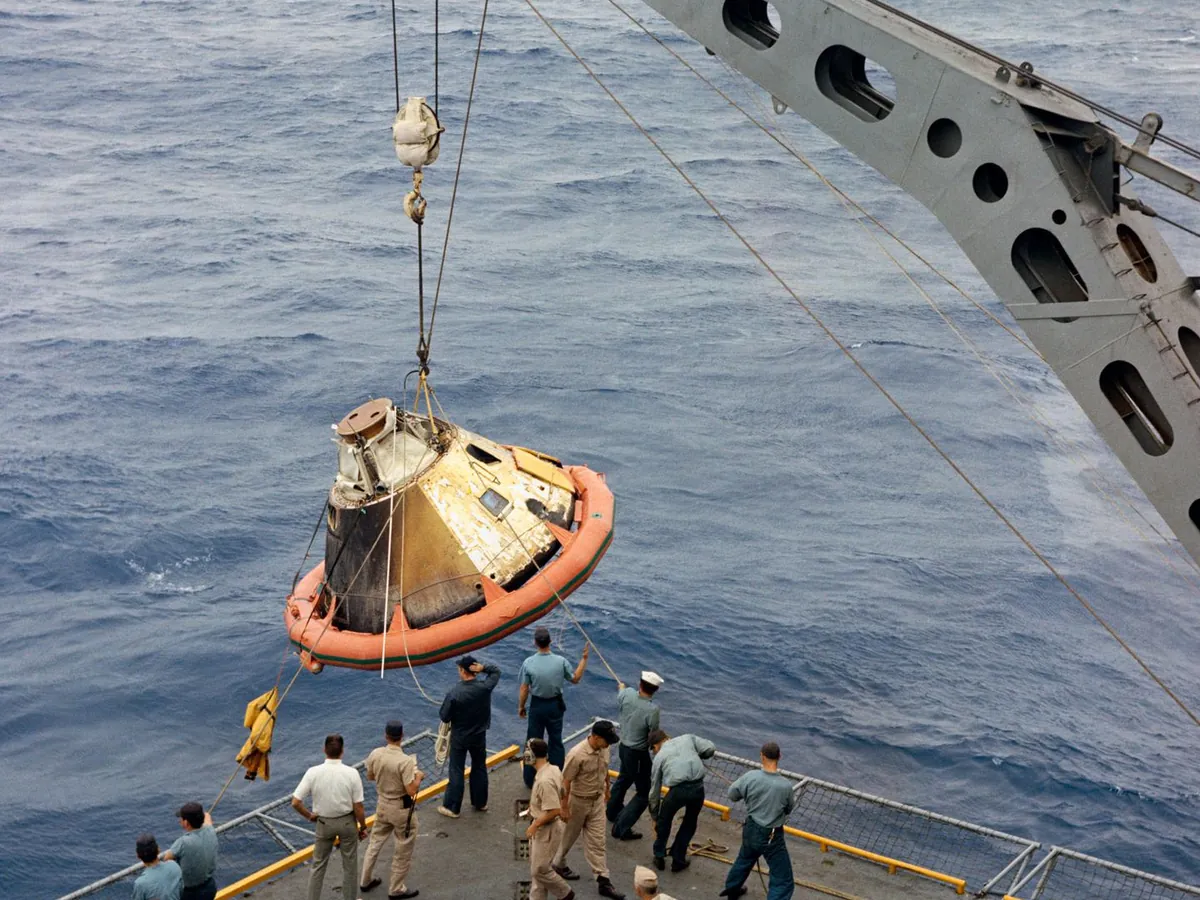
Today there are more options. Dragon uses PICA-X, Orion still uses Avcoat, and Shenzhou and Soyuz use their own low-density ablators. Same principle, different recipes. The Space Shuttle took the reusable route, covering most of the orbiter in ceramic tiles and protecting the nose and wing leading edges with reinforced carbon-carbon. On February 1, 2003, Columbia broke apart during reentry because foam shed from the external tank at launch had punched a hole in the left wing's leading edge, letting hot gas into the wing. It was a reminder that thermal protection is a system that has to be fully validated, not a part you simply install.
The Entry Corridor: Too Shallow Skips, Too Steep Crushes
The entry interface is usually set at about 120 km altitude. Come in too shallow and the capsule can bounce off the atmosphere back into space. Come in too steep and deceleration and heating spike beyond what the structure or the crew can take. Between the two lies a narrow entry corridor. For a return from the Moon it is only a few tens of kilometers wide, and a small error in entry angle can mean not a slightly missed landing site but a failed mission.
That is why capsules do not simply fall. Apollo, Soyuz and Shenzhou all offset their center of mass from the geometric axis, so the capsule flies at a slight angle of attack and generates a little lift. Rolling the capsule steers that lift, flattening the trajectory and correcting the landing point. In a normal Soyuz reentry the crew experiences about 3 to 4 g. If control is lost and the capsule falls back on a ballistic entry, the load climbs above 8 g. Soyuz TMA-11 made just such a ballistic return in April 2008 and landed about 470 km from its target.
At higher speeds, lift can even be used to skip like a stone on water. On December 17, 2020, China's Chang'e 5 return capsule, carrying lunar samples, entered the atmosphere at about 120 km altitude at close to Earth's escape velocity, about 11.2 km per second. After slowing down, it climbed back out of the atmosphere, coasted, and then reentered, landing in Siziwang Banner in Inner Mongolia. Two entries stretched out the deceleration and lowered the peak loads and heating.
Blackout: Minutes Without Contact
During reentry, the heat in the shock layer dissociates air molecules and ionizes atoms, wrapping the capsule in an electrically conducting plasma sheath. Radio waves are absorbed and reflected by it, cutting off communication between the ground and the spacecraft. This is blackout. On Apollo missions it typically lasted three to four minutes, and for the Chang'e 5 return capsule about three minutes. During those minutes, nobody on the ground can confirm the spacecraft's condition.
Modern missions try to shorten blackout, for example by relaying through satellites from the wake side of the vehicle, where the plasma is thinner, but it is very hard to eliminate. The plasma is a physical consequence of entering an atmosphere at orbital speed, not a defect that can be patched.
The Last Ten Kilometers
Only once the capsule has slowed below the speed of sound do things get gentle. On Shenzhou, at about 10 km altitude a pilot chute and then a drogue deploy, followed by a main canopy of about 1,200 square meters that brings the descent rate down to about 8 meters per second. About 1 meter above the ground, four retro-rockets fire and cut the touchdown speed to 1 to 2 meters per second. Soyuz has a main canopy of about 1,000 square meters and likewise fires its soft-landing engines about a meter above the ground. Since Shenzhou-12 in 2021, Shenzhou capsules have landed at the Dongfeng landing site in Ejin Banner, Inner Mongolia, while Soyuz comes down on the steppe of Kazakhstan.
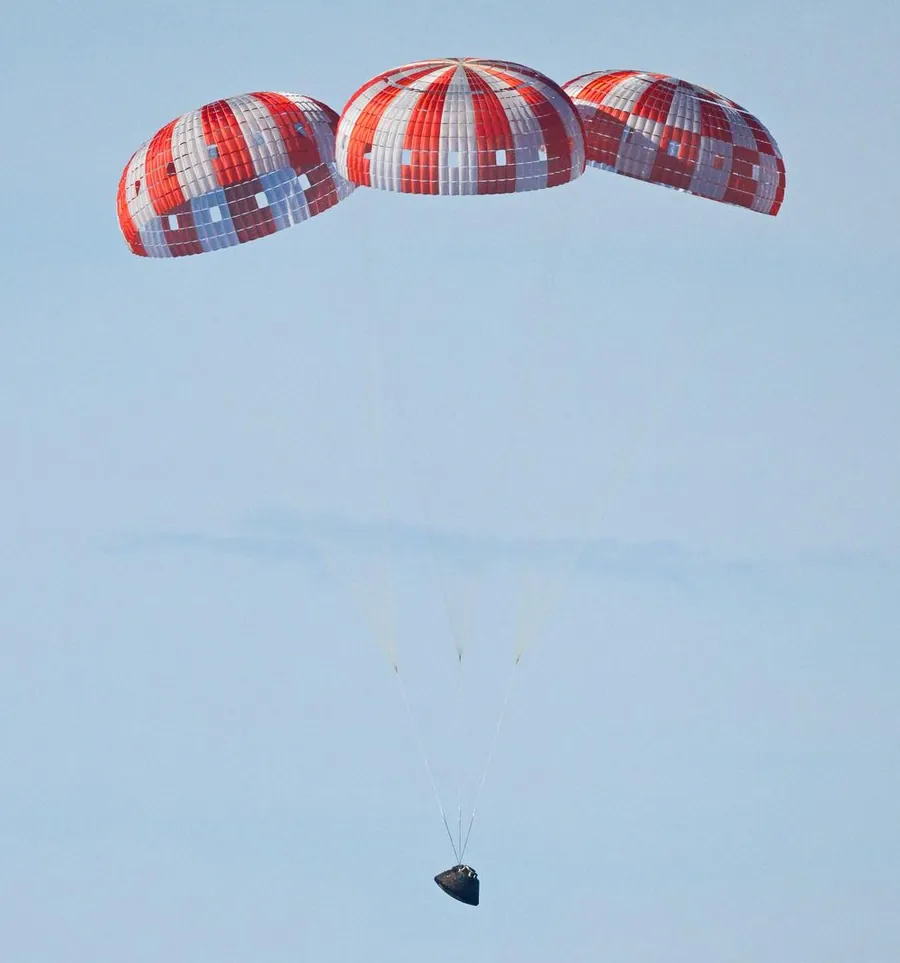
From 30 megajoules per kilogram to a touchdown at a meter or two per second, not one step relies on a bigger engine. It takes a blunt nose, a shell willing to burn, a narrow corridor and a system that keeps working on its own through blackout. Reentry pulls spaceflight out of grand narrative and back into concrete engineering constraints. 7.8 km per second is not a romantic number. It is an energy debt that has to be settled precisely, every single time.
In Solar Explorer, select the International Space Station or China's Tiangong space station and the info panel shows its speed and distance from Earth in real time. That speed of more than 7 km per second is exactly the debt its crews have to pay off on the way home.