Europa:
An Ocean Under the Ice With Twice Earth's Water
Europa's surface sits near -160°C, yet under its ice there is very likely an ocean holding about twice the water of Earth's oceans. Europa Clipper reaches Jupiter in 2030.
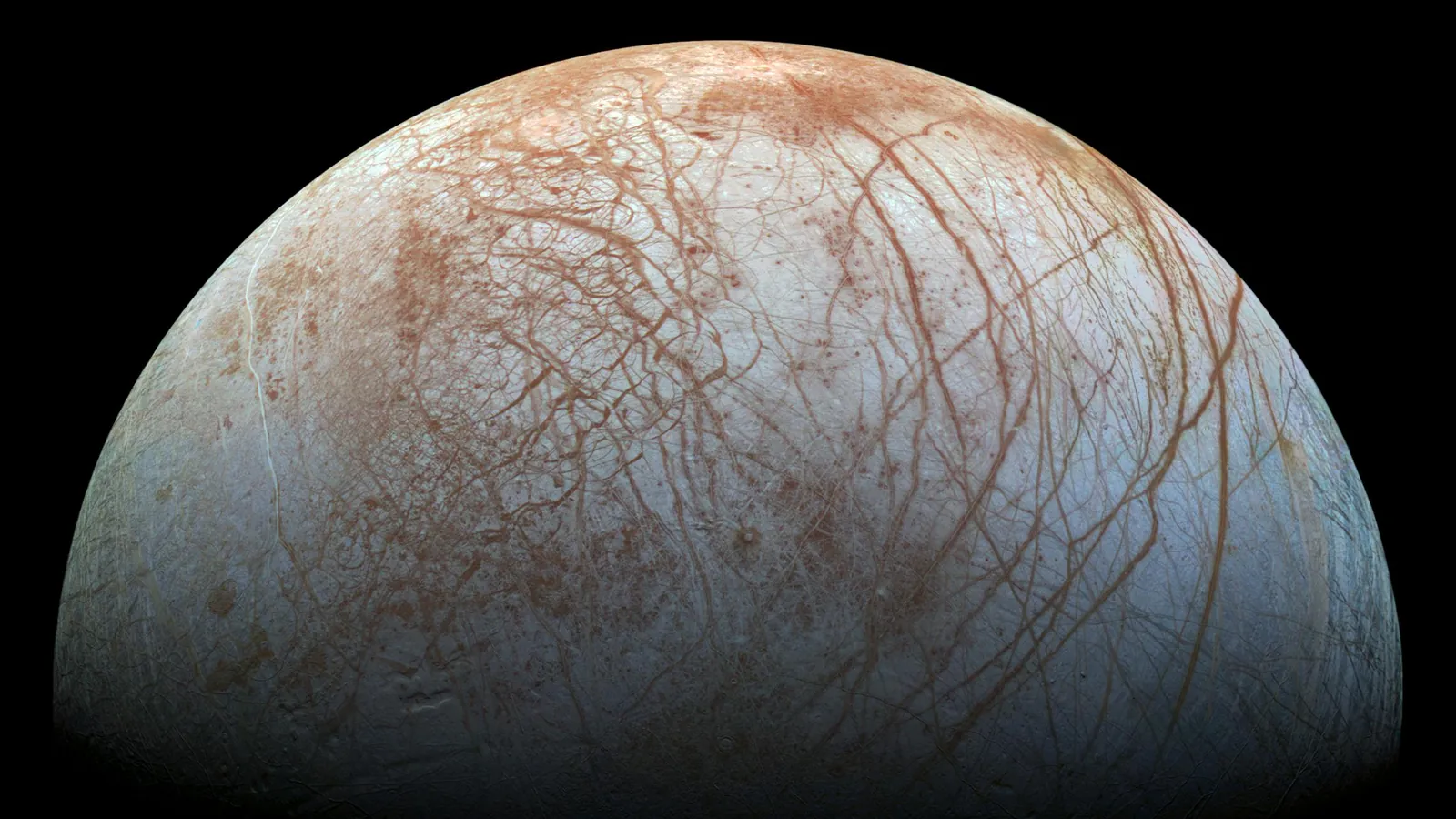
In January 1610, Galileo pointed his homemade telescope at Jupiter and noticed four "stars" shuttling back and forth beside it. These moons, later known as the Galilean satellites, showed that not everything in the sky circles Earth, giving Copernicus's Sun-centered model a piece of direct observational support. The smallest of the four is Europa. At 3,121 km across it is a little smaller than our Moon (3,474 km), and its surface sits at about -160°C. By every outward sign it is an ordinary ball of ice. Yet today it is one of the most discussed bodies in planetary science, for one reason: beneath its ice shell there is very likely a global ocean of liquid water, holding roughly twice as much water as all of Earth's oceans combined.
Why there is liquid water under the ice
The first question is obvious. Europa is about 780 million km from the Sun and its surface is at -160°C. How can there be liquid water at all? The answer is tidal heating. Europa circles Jupiter every 3.55 days on a slightly eccentric orbit. Each time it swings closer to Jupiter and then pulls away, the giant planet's tides stretch and squeeze its interior, and that friction generates heat. The eccentricity is kept alive by a 1:2:4 orbital resonance with Io and Ganymede, so the tides never get to smooth it away.
None of this depends on sunlight. Io, closer to Jupiter and kneaded harder, has more than 400 active volcanoes. Europa sits farther out, heated more gently, right in the range where an ocean can survive under a shell of ice.
The evidence: magnetism, vapor and a young surface
The ocean is backed by observations. From 1995 to 2003 the Galileo spacecraft worked in the Jupiter system and flew past Europa many times. It found that Europa generates an induced magnetic field as it moves through Jupiter's own field. Only a conductive layer of salty water inside the moon can produce that signal. Since 2012, the Hubble Space Telescope has several times recorded what may be water vapor plumes over Europa's southern regions, although none has yet been confirmed.
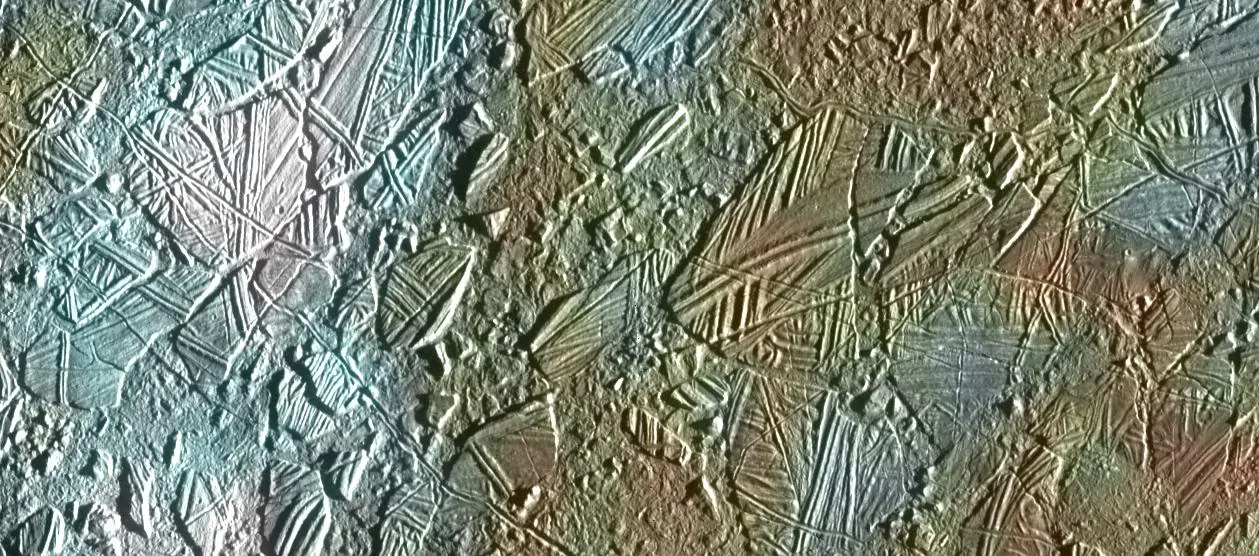
The surface is the other anomaly. Europa has remarkably few impact craters. Crater counts put the surface age at only 40 to 90 million years, while neighboring Callisto's surface is billions of years old. The ice shell keeps moving and renewing itself, which means something below is stirring it. NASA's current estimate is an ice shell about 15 to 25 km thick over an ocean about 60 to 150 km deep.
Why it matters
One leading idea for the origin of life on Earth is the deep-sea hydrothermal vent: bring liquid water, energy and chemistry together, and life might get started from non-living matter. If Europa's seafloor has similar hydrothermal activity, all three ingredients may be present. The water is there, tidal heating supplies energy, and oxidants made by Jupiter's radiation in the surface ice may be carried down into the ocean as the shell turns over. That is why NASA treats Europa as a priority target in the search for habitable environments in the solar system.
Europa Clipper: studying the moon from Jupiter orbit
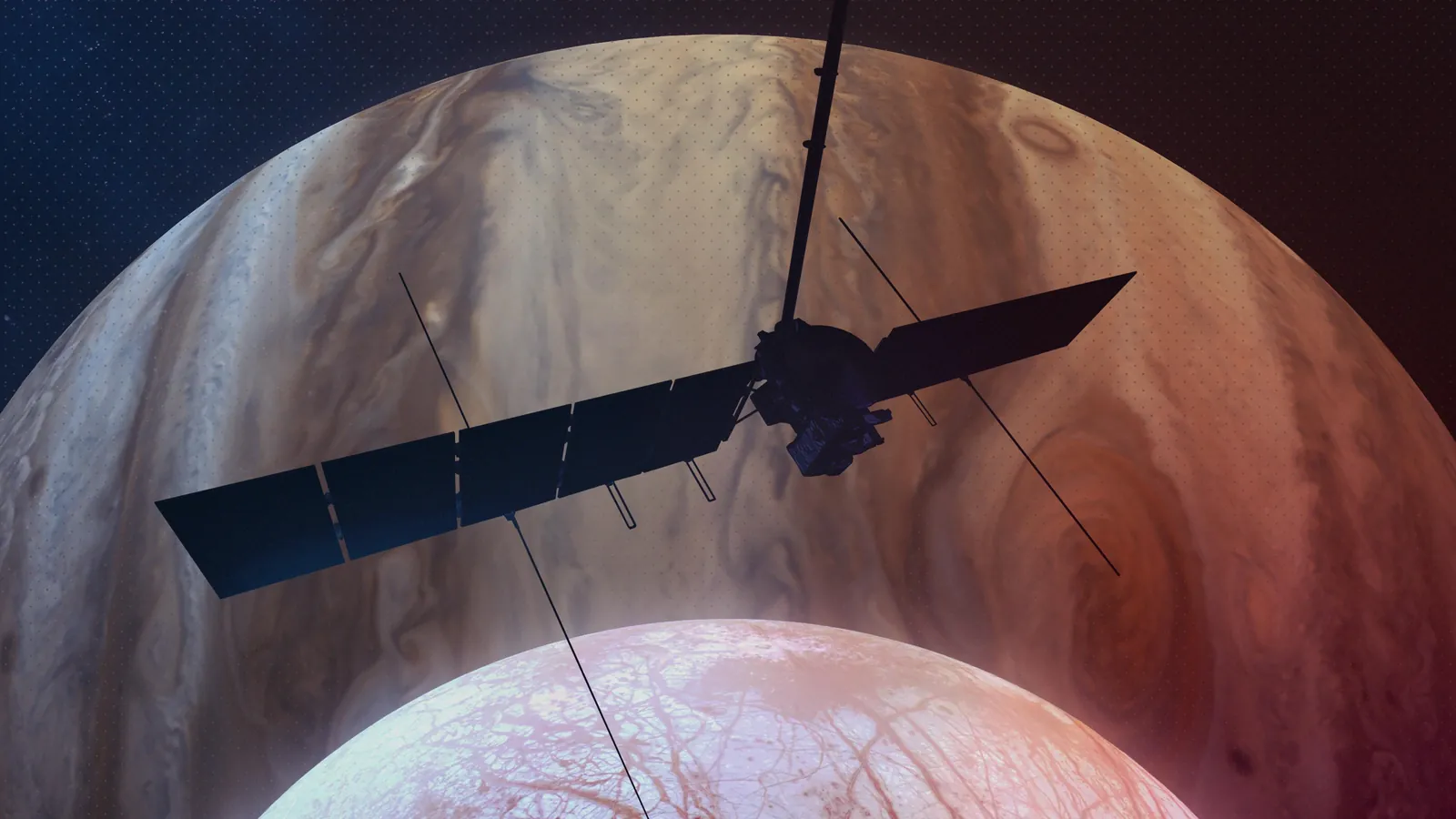
To answer the question, NASA built Europa Clipper, the largest spacecraft it has ever developed for a planetary mission. With its solar arrays deployed it measures 30.5 meters from tip to tip. It launched on a Falcon Heavy from Kennedy Space Center on October 14, 2024, and is not flying straight to Jupiter. It swung past Mars for a gravity assist on March 1, 2025, is scheduled to fly past Earth for another on December 3, 2026, and will enter orbit around Jupiter in April 2030. It will then use nine science instruments plus a gravity experiment to make 49 flybys of Europa, coming as close as 25 km above the surface, to measure the thickness of the ice, the depth of the ocean and the makeup of the surface.
Notice the orbit design. Clipper orbits Jupiter, not Europa. Europa sits deep inside Jupiter's radiation belts, and its surface receives about 5.4 sieverts a day, enough to give a person severe radiation sickness or kill them within a single day. Spacecraft electronics cannot survive long exposure either, so Clipper dives in for each flyby and then retreats. ESA's JUICE (Jupiter Icy Moons Explorer), launched in 2023, is also on its way and is scheduled to reach the Jupiter system in 2031, with Ganymede, Callisto and Europa all on its list.
The question it will answer
Europa Clipper is not looking for life directly. It is answering the question that comes first: does Europa have the conditions that could support life? If the answer is yes, the solar system gains a second candidate for a habitable environment beyond Earth, and that is only the story of the one star we happen to live next to.
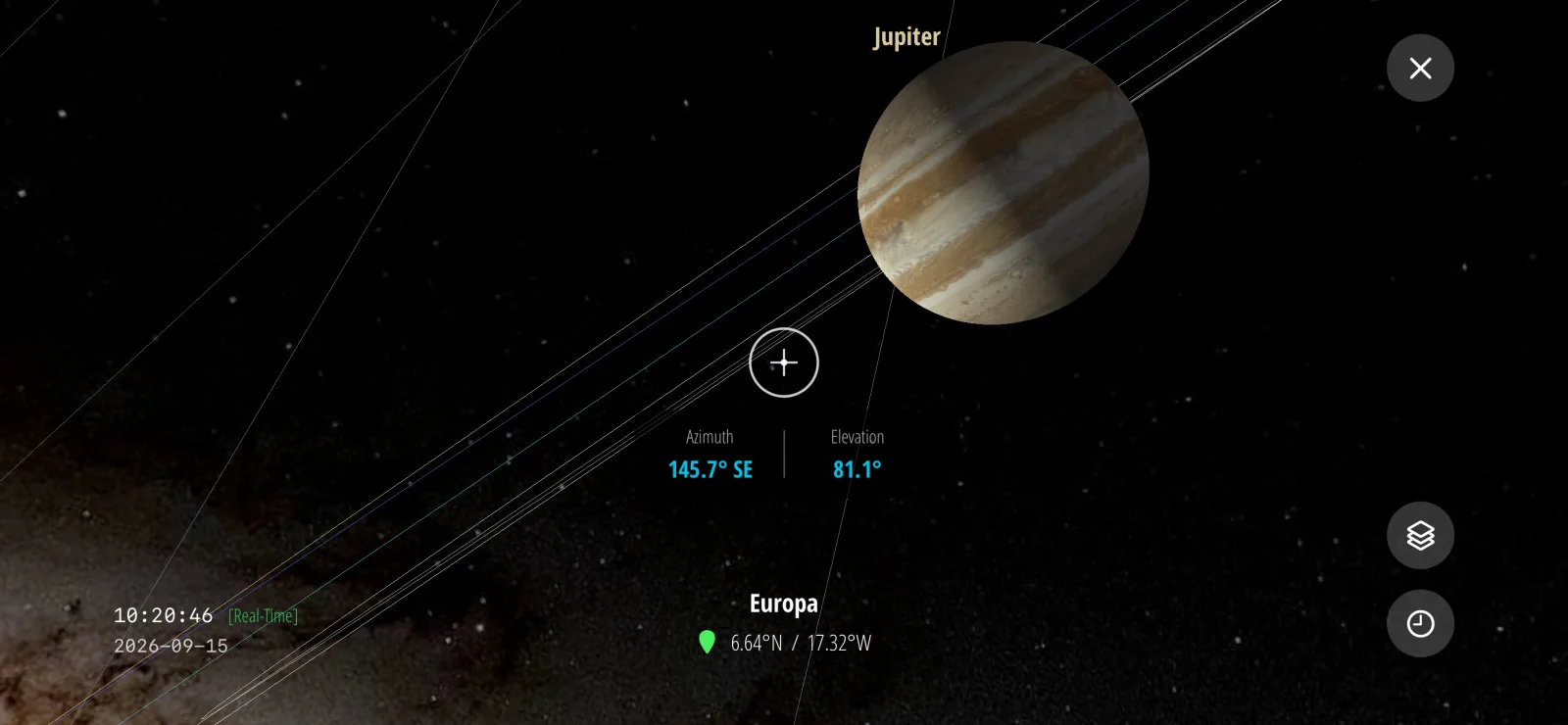
In Solar Explorer you can use the landing view to stand on Europa and watch Jupiter hang in its sky. Set time evolution to 1 day per second and Europa's 3.55-day orbit plays out in a few seconds. The mission replays also include Europa Clipper's route, with the 2030 to 2034 segment shown as a predicted trajectory.