Neptune:
The Planet Found With Pen and Paper
In 1846 Johann Galle found Neptune in under an hour, less than 1 degree from where Le Verrier's math pointed. Newton's gravity triumphed. The later Planet X was a mistake.
On the night of September 23, 1846, something without precedent in the history of science happened at the Berlin Observatory. A planet was found, and the man who had calculated its position had never seen it, nor even looked in its direction. That morning, Johann Galle at the observatory received a letter from the French astronomer Urbain Le Verrier. It asked him to point his telescope at a patch of sky near the border of Capricornus and Aquarius, where an undiscovered planet should be, showing a small disk. That night Galle and the student Heinrich d'Arrest started searching. In less than an hour they found an eighth-magnitude star that was not on their chart, less than 1 degree from where Le Verrier had said it would be. Over the following nights it moved against the stars. The planet was Neptune, located first with pen and paper and then confirmed through a telescope.
Uranus misbehaves
To see how hard this was, go back to 1781. That year William Herschel discovered Uranus with a reflecting telescope he had built himself, the first planet ever found with a telescope. Over the following decades astronomers drew up tables of its motion, and the tables kept going wrong. Alexis Bouvard's tables of 1821, based on Newtonian gravity, soon disagreed with new observations. The error grew year after year, and by the 1840s it had reached about an arcminute or more, too large to blame on observing mistakes.
There were two broad explanations. Either the observations and tables were flawed, or Newton's law of gravitation broke down at the edge of the solar system. In the 1840s the second option was a very big deal. Since the Principia appeared in 1687, Newtonian gravity had become the foundation of all celestial mechanics, explaining the motion of the Moon and predicting the return of Halley's Comet in 1759.
Le Verrier's inverse problem
Le Verrier took a third path: there was an unknown planet beyond Uranus, tugging on it with its gravity.
That sounds natural today, but at the time it meant enormous calculation. From the deviations in Uranus's orbit you had to work backward to an unknown body's mass, orbital size, eccentricity, inclination and current position in the sky. It is a highly nonlinear inverse problem, with only the "deviations" known and five or six unknowns, solved without computers, by hand and with tables of logarithms.
Le Verrier pulled it off. On June 1, 1846, he presented the predicted position of the unknown planet to the French Academy of Sciences, and on August 31 he added its mass and orbit. On September 18 he wrote to Galle at the Berlin Observatory asking him to search. Galle first looked for a disk, as the letter suggested, without success. It was d'Arrest who proposed checking star by star against a new chart of that region recently drawn by Carl Bremiker. Galle called out star positions at the eyepiece while d'Arrest compared them with the chart, until d'Arrest exclaimed: "That star is not on the map!"
Adams and the priority dispute
At almost the same time, John Couch Adams, a young mathematician in Cambridge, had independently reached a similar result. In the autumn of 1845 he sent his calculations to the Astronomer Royal, George Airy. Airy replied with a question, Adams did not answer promptly, and the matter stalled. Only in July 1846 did James Challis, director of the Cambridge Observatory, begin searching that part of the sky. He recorded Neptune twice, on August 8 and 12, but without an up-to-date star chart he failed to recognize it.
After the discovery, Britain and France argued over priority for decades. The fairest view today is that both men worked out the answer independently, but Le Verrier's prediction was more accurate, published first and actively pushed toward observation, so the main credit is his. What really deserves attention is not who came first but that a theory had, for the first time, become precise enough to point to a completely unknown body, and was confirmed by observation within days.
The right answer for the wrong reason
There is an interesting flaw in Le Verrier's work. His position was accurate to within 1 degree, but his distance was well off. He gave a semi-major axis of about 36 astronomical units, Adams about 37, while Neptune's actual value is about 30.1. Both had assumed the unknown planet's distance roughly followed the Titius-Bode rule. Their orbits happened to lie close to the real one over the stretch covered by observations, so the position came out right. The right answer for the wrong reason is a reminder that a correct prediction does not automatically mean every step of the reasoning behind it holds.
Even so, in 1846 this was powerful evidence for Newtonian gravity. The irony is that 13 years later, in 1859, Le Verrier himself found that a small part of the precession of Mercury's perihelion could not be explained by Newton's law, a discrepancy later refined to about 43 arcseconds per century. He tried to explain it with another unseen planet, Vulcan, which was never confirmed. That crack was finally closed by Einstein's general relativity in 1915.
Neptune itself
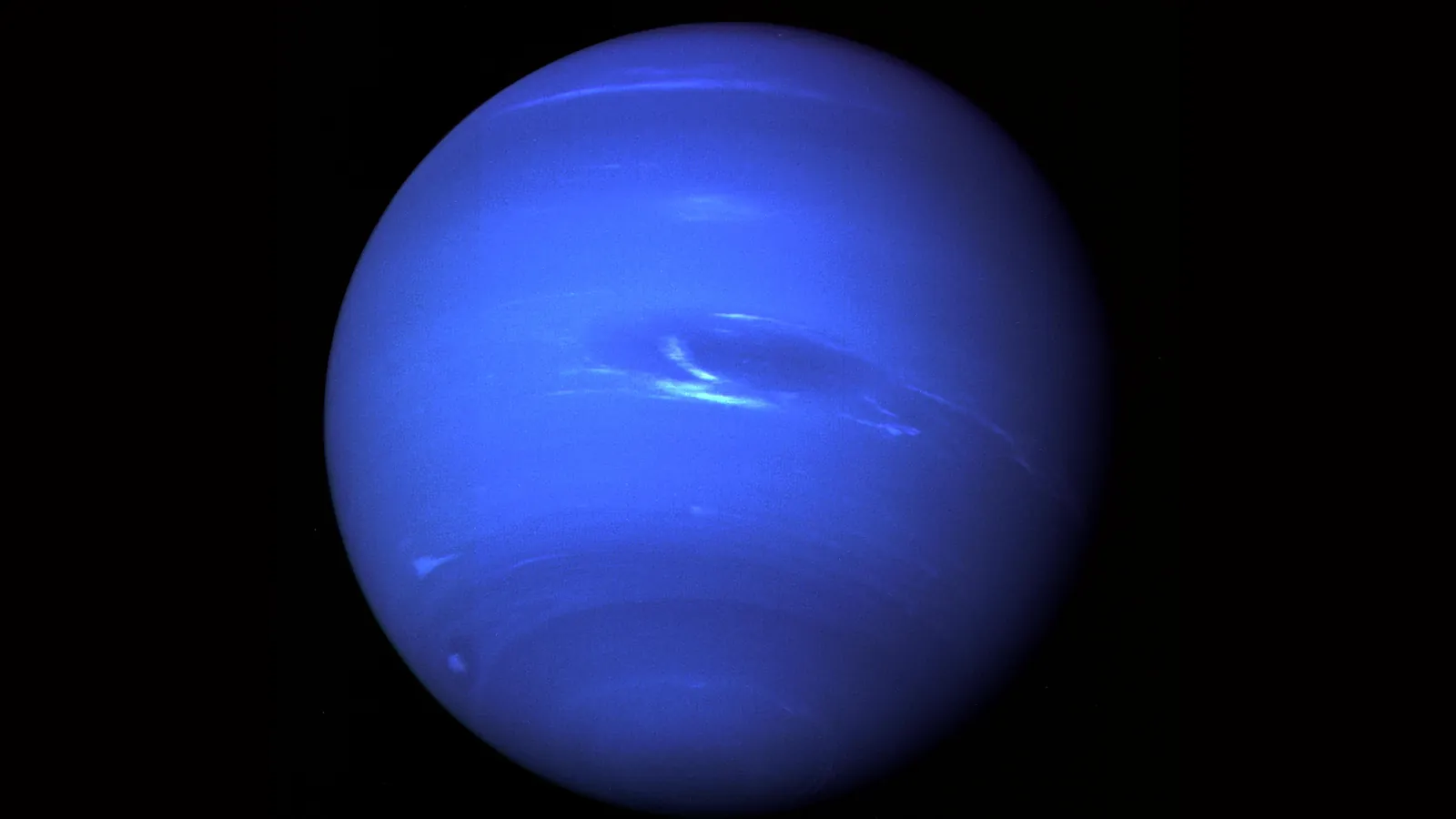
Neptune lies about 4.5 billion km from the Sun, about 30 astronomical units, and takes 164.8 years to complete an orbit. It was discovered in 1846 and only completed its first full orbit since then in July 2011. We have known it for 165 years, and it has lived through one Neptunian year. A day on Neptune lasts about 16 hours 6 minutes.
Neptune receives only about 1/900 of the sunlight Earth does, yet it radiates about 2.6 times as much energy as it absorbs, which means its interior is still giving off heat by a mechanism not yet settled. Its winds exceed 2,000 km/h, several times faster than the winds around Jupiter's Great Red Spot, even though Neptune has far less energy to work with than Jupiter. That contradiction is one of the central puzzles of Neptune's atmosphere.
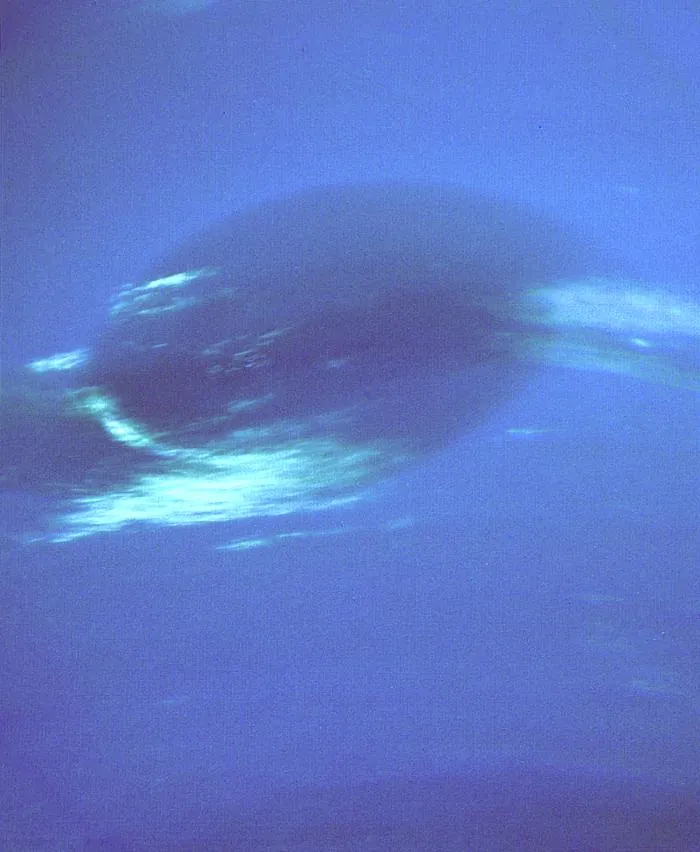
On August 25, 1989, Voyager 2 flew past Neptune, the only spacecraft visit so far. It photographed an Earth-sized anticyclone, the Great Dark Spot, and a fast-moving bright cloud nicknamed the "Scooter." When Hubble looked again in 1994, the Great Dark Spot was gone. Storms like it last only a few years, unlike Jupiter's Great Red Spot, which has persisted for well over a century. The familiar deep-blue Neptune is also color-enhanced. A 2024 University of Oxford study showed that its true color is a pale greenish blue, close to that of Uranus.
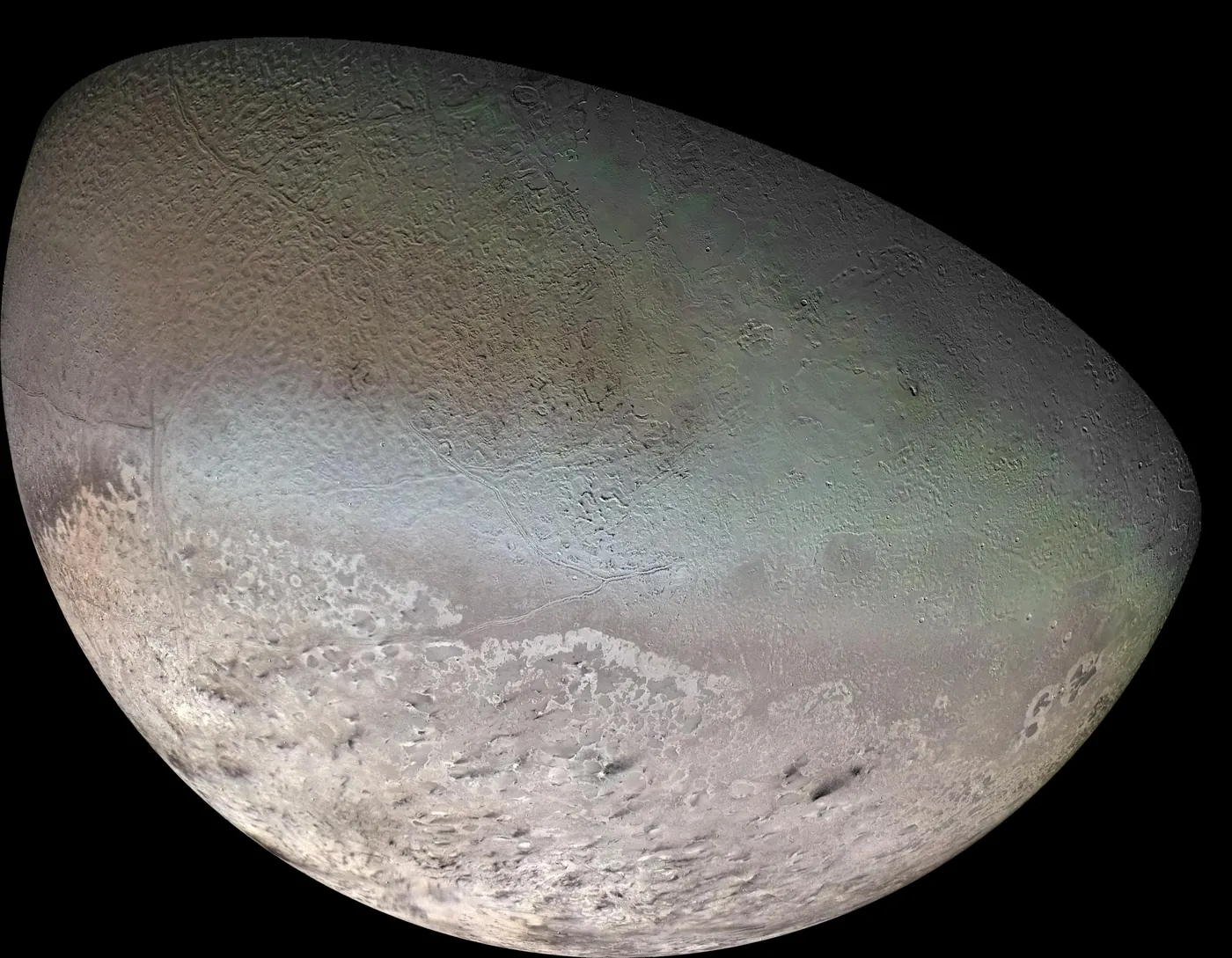
Voyager 2 also photographed Triton. It orbits Neptune backward, in a retrograde direction, and is probably a Kuiper Belt object that Neptune captured. Its surface is about 38 K (about -235°C), yet nitrogen geysers erupt from it. Its orbit is slowly decaying, and in a few billion years it will be torn apart by tides or crash into Neptune.
The Planet X that never was
Discovering Neptune did not make the leftover errors in Uranus's orbit disappear completely, so astronomers went looking for a "Planet X" farther out. Percival Lowell made extensive calculations in the early 1900s, and in 1930 Clyde Tombaugh, comparing photographic plates at Lowell Observatory, found Pluto near the predicted position.
But Pluto was too small. After its moon Charon was discovered in 1978, Pluto's mass worked out to only about 0.2 percent of Earth's, far too little to disturb Uranus noticeably, and Planet X was in doubt again. The real answer came after Voyager 2. Its flyby measured Neptune's mass precisely, about 0.5 percent lower than earlier estimates, a difference comparable to the mass of Mars. In 1993, Myles Standish at the Jet Propulsion Laboratory recalculated with the new mass, and the Uranus discrepancies vanished.
The Planet X that Lowell spent years calculating, and that Tombaugh hunted through countless plates on cold nights, was a mistake caused by imprecise measurements all along. Pluto was a beautiful by-product of that mistake: real, but never the Planet X it was mistaken for. From "calculating a planet" to "calculating a planet that does not exist" took 143 years, and the dividing line was not mathematics but precision of measurement. Many ghosts in science disappear this way, not refuted but measured away by a more accurate ruler.
Modern astronomy runs this process every day. An Earth-sized planet crossing a Sun-like star dims it by only about one part in ten thousand, and the transit method has found thousands of exoplanets from changes like that. Gravitational wave detectors measure changes in the length of 4 km arms smaller than a thousandth of the width of a proton. Neptune was the first success of "calculate first, look second," and today astronomers do it as a matter of routine.
To get a feel for how slow Neptune is, open Solar Explorer, bring the view out to Neptune's orbit and set time evolution to 1 week per second. Even then, one orbit around the Sun takes more than two hours, and those two hours on screen stand for 165 years in reality.