The Roche Limit:
Why Saturn's Rings Neither Scatter Nor Grow Into Moons
Within about 2.2 Saturn radii, tides tear an icy moon apart and stop fragments from regrouping. Saturn's main rings end right at this line, the Roche limit.
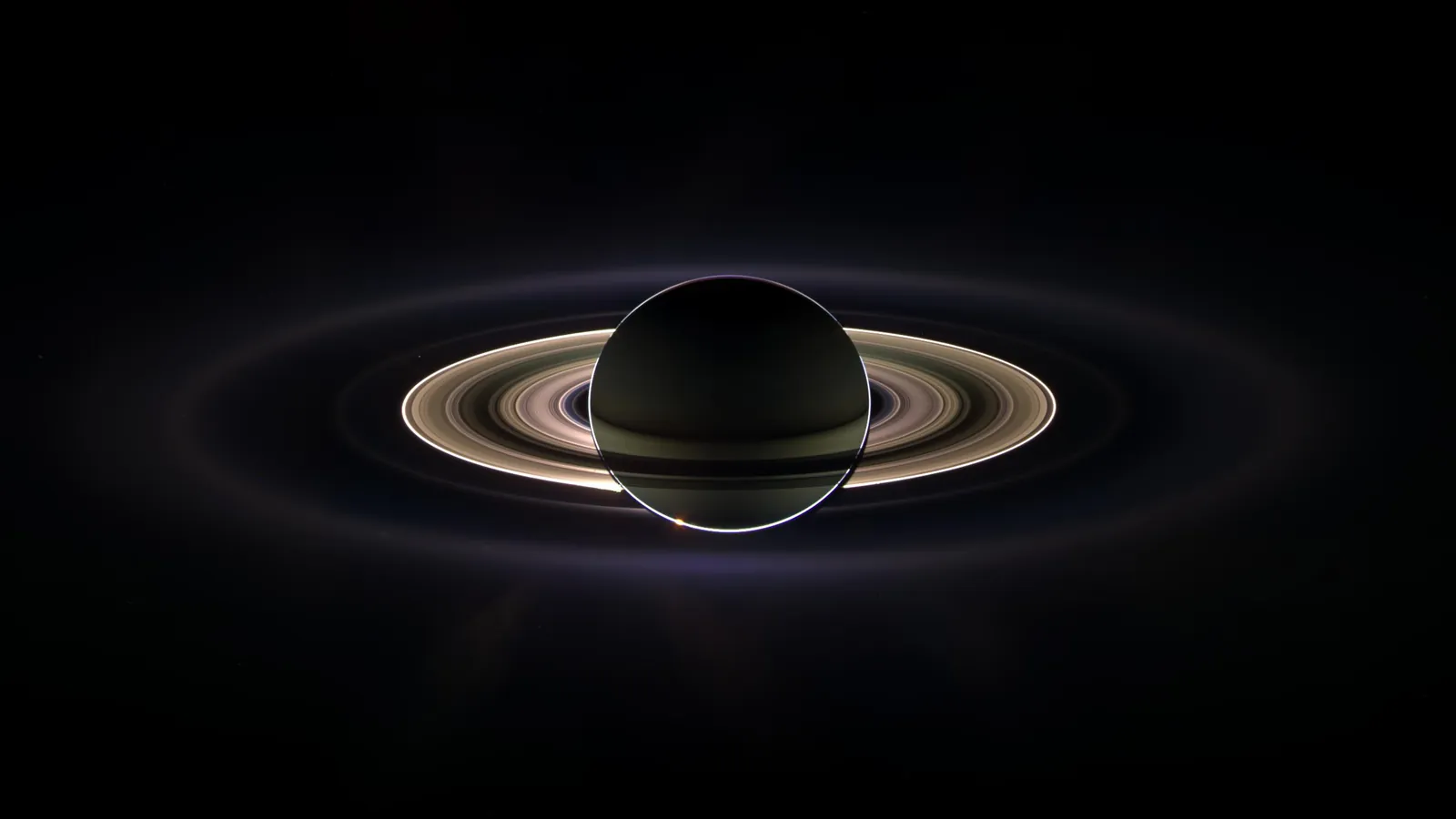
In 1610, Galileo pointed his telescope at Saturn and saw what looked like a pair of "ears" on either side of the planet. He took them for two moons hugging Saturn. For nearly half a century, astronomers argued about what those ears were. In 1655, Christiaan Huygens observed Saturn with a better telescope he had ground himself, and in 1659 his book Systema Saturnium gave the answer: Saturn is surrounded by a thin, flat ring that touches the planet nowhere. Today we know the ring is not decoration. It is the shape a physical boundary carves into the solar system. Within about 2.2 Saturn radii of the planet's center, an icy moon simply cannot survive. That boundary is called the Roche limit.
Tidal force: the near side is pulled harder
Start with the right question. Why are Saturn's rings a disk and not a moon orbiting the planet? The answer is not in the rings themselves but in where they sit.
In 1687, Newton's Principia set out the inverse-square law of gravity. It means that different parts of an extended body feel different pulls from another body: the near side is tugged harder than the far side. The difference between those pulls is the tidal force. It does not change the body's overall orbit, but it quietly stretches the body from end to end. Earth's ocean tides are exactly this, driven by the Moon and the Sun.
Roche's number
In 1848, the French astronomer Édouard Roche turned this into a criterion you can calculate. When a body held together only by its own gravity comes within a certain distance of a larger one, the tidal force from the larger body exceeds the smaller body's self-gravity, and it is torn apart. That critical distance is the Roche limit. For a fluid body it is
d ≈ 2.44 R (ρ_M / ρ_m)^(1/3)
where R is the radius of the primary and ρ_M and ρ_m are the densities of the primary and the satellite. The 2.44 coefficient is for a fluid body, one with no material strength that is held together purely by gravity. A body with real strength, such as a solid chunk of rock, can survive closer in, with a coefficient of about 1.26. That gap matters. It explains why some small bodies can exist inside a planet's Roche limit while an icy moon cannot: the rock has strength, the ice moon has only gravity.
Plug in Saturn, and it lands on the rings
Put in Saturn's numbers and theory meets observation. Saturn's mean density is about 0.687 g/cm³, lighter than water, while the ring particles are almost pure water ice at roughly 0.9 to 1.0 g/cm³. With the 2.44 coefficient, the Roche limit comes out at about 2.15 to 2.23 times Saturn's equatorial radius, or roughly 130,000 to 134,000 km from the planet's center. If the ring particles are loose, fluffy clumps of ice with lower density, the line moves farther out.
The A ring, the outer of Saturn's main rings, ends at about 136,775 km, or about 2.27 Saturn radii, almost exactly on that line. Just beyond it lie the narrow F ring and a few small moons such as Prometheus and Pandora, poised between gathering and scattering. Only farther out do real moons appear. Mimas orbits about 186,000 km from Saturn's center, already outside the Roche limit.
So the outer edge of the rings is not arbitrary. Inside the line, the tidal pull separating fragments beats their mutual gravity, and they cannot gather into a moon. Outside it, collisions are more likely to make material stick, and that is where real moons are found. A ring is not leftover junk. It is the stable product of a long tug-of-war between tides and self-gravity. The main rings of Saturn, Jupiter, Uranus and Neptune mostly lie inside or near their planets' Roche limits, and that is no coincidence.
A breakup caught on camera
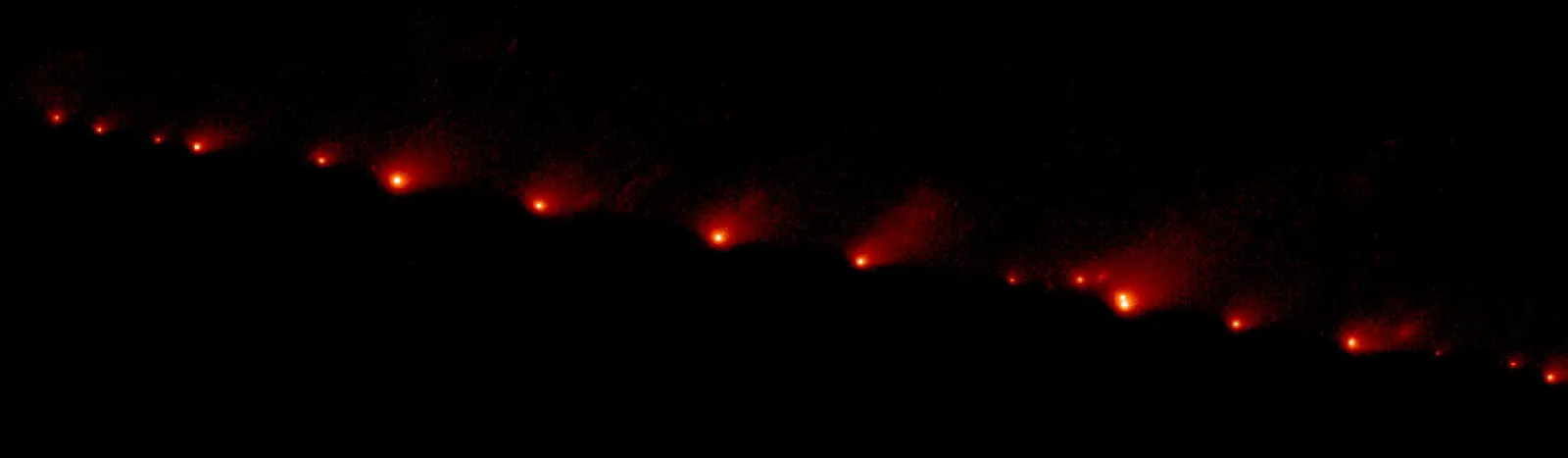
The solar system once put this process right in front of us: Comet Shoemaker-Levy 9. Captured by Jupiter and orbiting the planet, the comet swept past on or around July 7, 1992, just a few tens of thousands of kilometers above the cloud tops, deep inside Jupiter's Roche limit. Jupiter's tides tore the nucleus into a string of fragments on the spot. By the time Eugene and Carolyn Shoemaker and David Levy discovered it in March 1993, it was already a "string of pearls." What they found was a comet that had already broken apart.
From July 16 to 22, 1994, its 21 fragments, labeled A through W, slammed one after another into Jupiter's southern hemisphere at about 60 km per second. The dark rings left by fragment G spanned about 12,000 km, roughly the size of Earth, and some of the scars lingered in Jupiter's atmosphere for months. It was the first time humans directly observed a collision between bodies in the solar system, and the moment the Roche limit went from formula to photograph.
A disk thinner than paper
Spacecraft have also changed how we see Saturn's rings. Cassini orbited Saturn from 2004 to 2017. Before its fuel ran out it dived repeatedly through the gap between the planet and its innermost rings, and on September 15, 2017, it plunged into Saturn's atmosphere. According to NASA, the main rings are typically only about 10 meters thick, while the outer edge of the A ring is about 270,000 km across. Shrink the main rings until they are as thick as a sheet of paper (0.1 mm), and they would still be about 2.7 km in diameter.
Cassini also found that the rings hold much less mass than once thought, about 40 percent of the mass of Mimas. Low mass and a "clean" color led many researchers to conclude that the rings are quite young, perhaps around 100 million years old or less, a blink of an eye against the solar system's 4.6 billion years. Other studies argue that processes such as micrometeoroid impacts could keep old rings looking clean, so the rings might be nearly as old as Saturn itself. The debate is still open.
Position shapes form
What the Roche limit really says is that position shapes form. Whether a body stays whole or breaks apart depends not only on the body itself but on where it is. The same ice is a ring inside the limit and a moon outside it.
The criterion is not just theory. Mars's moon Phobos is spiraling inward by about 1.8 meters per century. In a few tens of millions of years it will cross Mars's Roche limit and be torn into a new ring, or fall straight into the planet. The solar system's next ring may already be on a countdown.
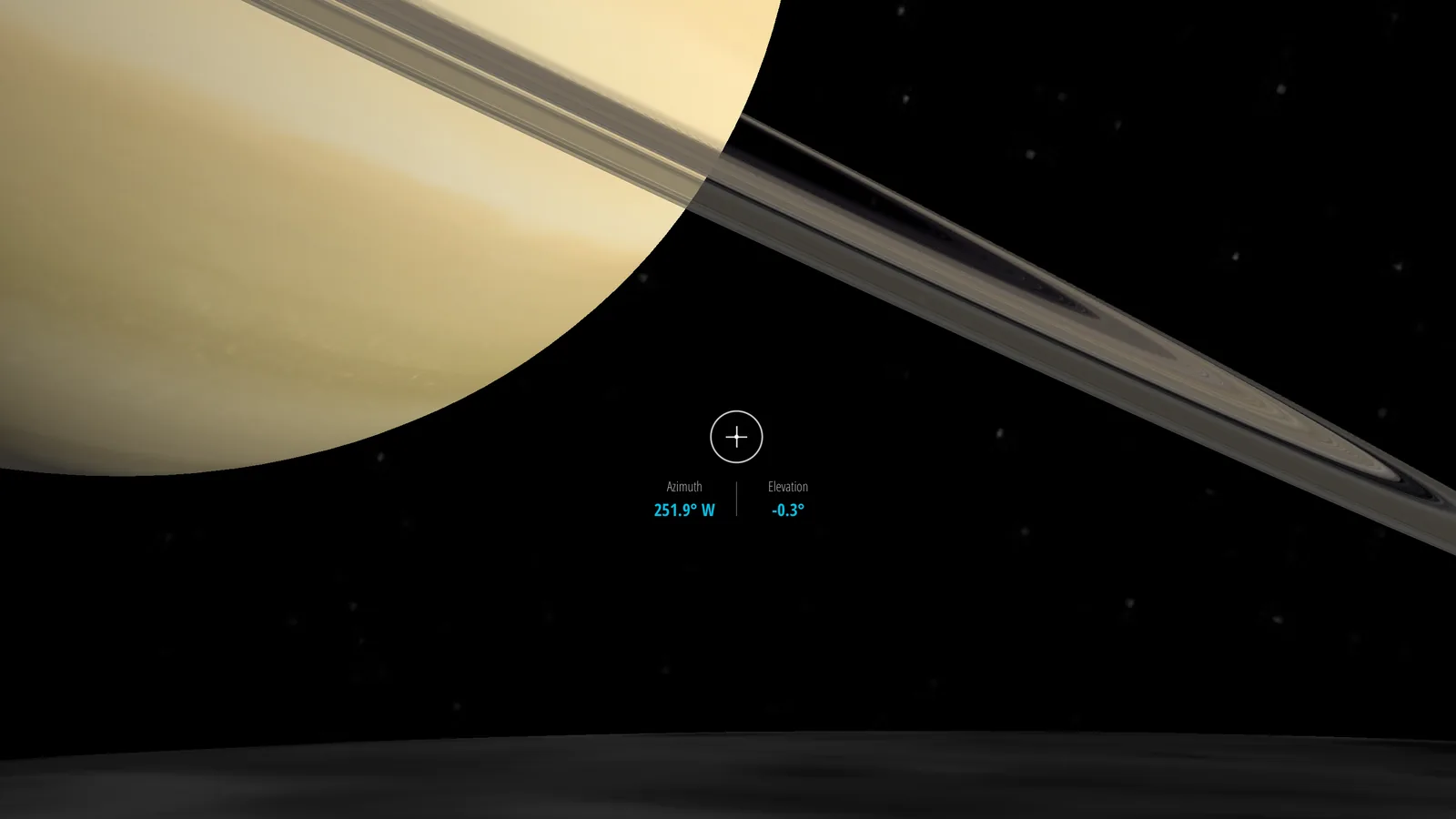
In Solar Explorer you can use the landing view to stand on Mimas and look at Saturn. Mimas orbits almost exactly in Saturn's equatorial plane, so from there Saturn spans about 38 degrees and the rings are seen nearly edge-on, a band of light slanting across the sky. Mimas orbits about 3.1 Saturn radii from the planet's center, outside the Roche limit, which is why this icy moon about 400 km across can hold together.