SN 1054:
The Guest Star in the Song Dynasty Records
In 1054, Song dynasty astronomers logged a guest star seen in daylight for 23 days. Nearly 900 years later, it was confirmed as the supernova that created the Crab Nebula.
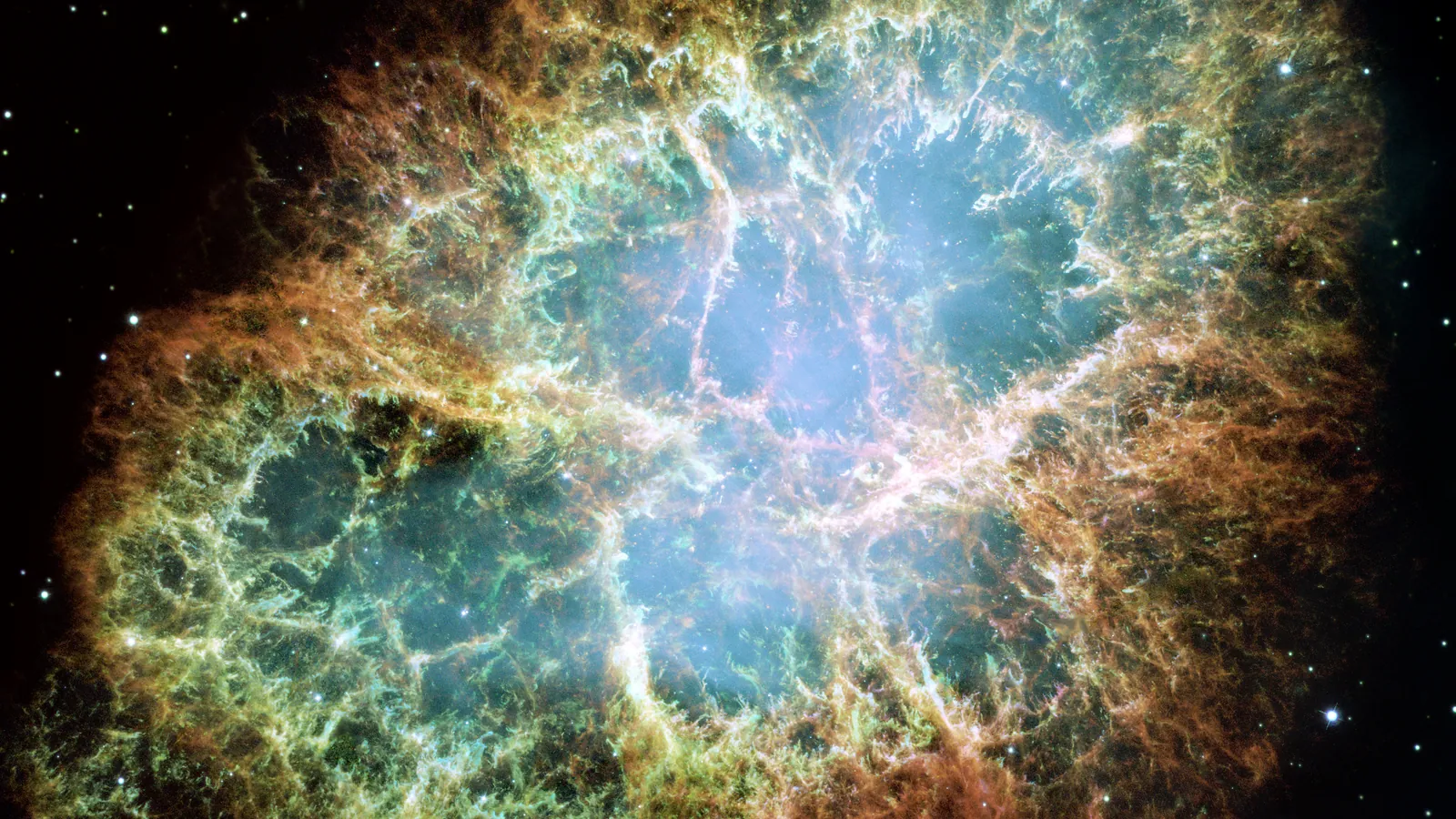
The supernova of 1054 holds a special place in the history of astronomy. It is one of the most thoroughly documented supernovae in human records, and those records come mainly from the court of China's Northern Song dynasty. To appreciate it, it helps to separate three questions: what observers actually saw, how later astronomers matched it to a nebula in the sky, and what kind of object it really was.
What Observers Saw
On the jichou day of the fifth month of the first year of the Zhihe era, July 4, 1054, a bright star appeared in the eastern sky before dawn, a little to the southeast of the star Tianguan (today's Zeta Tauri in Taurus). Chinese astronomers called objects that appeared suddenly and later vanished "guest stars" (客星), in contrast to the fixed stars that were always there. A guest, as opposed to a host, comes and goes, and the name itself captures that judgment.
The Song Huiyao records that it was "visible by day like Venus, with pointed rays in all four directions, reddish-white in color, seen for twenty-three days in all", meaning it was as bright as Venus in daylight for 23 days. The History of Song notes that it "appeared several inches southeast of Tianguan and faded after more than a year". On the 22nd day of the seventh month (August 27, 1054), Yang Weide, a court astronomer who had served as deputy director of the Astronomical Bureau, reported that the star had "a faint shimmer above it and was yellow", and read it, according to the omen texts, as a sign that the realm had a man of great worth. Only in the third month of the first year of the Jiayou era (April 1056) did the Astronomical Bureau report that the guest star had disappeared, after about 21 months of naked-eye visibility at night.
Observers in Japan and the Arab world also left records, but the Song accounts are the most systematic, covering position, brightness and duration. Their value lies in being a timestamp. In 1054 there were no telescopes, only eyes and ink, yet those written naked-eye notes later became the key evidence for tying a supernova remnant to a specific year.
From Guest Star to M1: A Long Chain of Inference
Connecting the guest star in the chronicles to a nebula in the sky took more than two centuries:
- 1731: English observer John Bevis recorded a faint, cloudy object in Taurus.
- 1758: French astronomer Charles Messier came across it while following a comet. To stop mistaking such diffuse objects for comets, he began compiling a catalog of nebulae and star clusters, and this object became number 1, or M1.
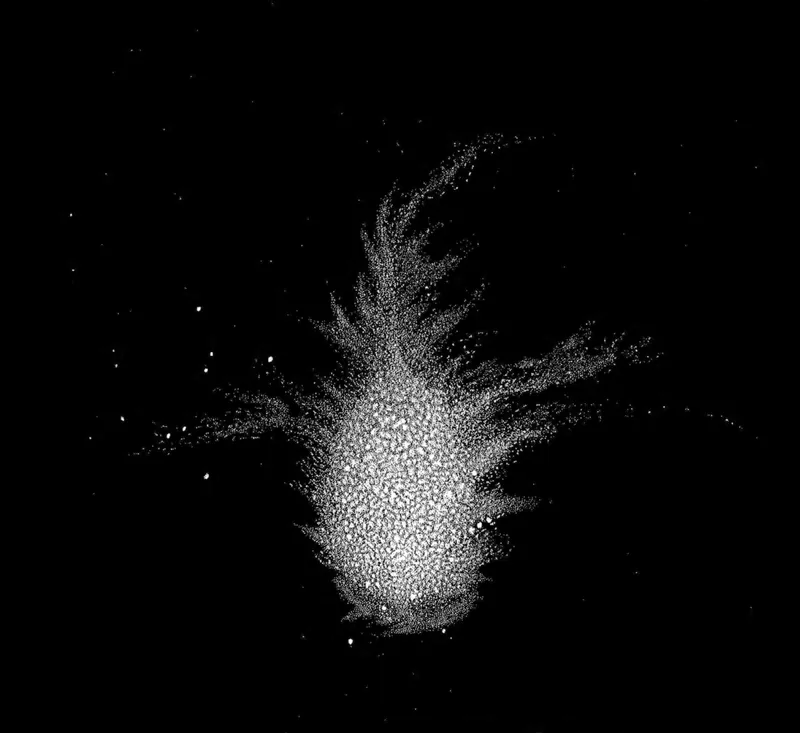
- Around 1844: In Ireland, Lord Rosse (William Parsons) drew it with a home-built reflecting telescope. The drawing looked like a crab, and the name "Crab Nebula" spread from there. A few years later he viewed it through his larger 72-inch telescope and could no longer see the crab shape, but the name stuck.
- 1921: John Charles Duncan compared photographic plates taken about 12 years apart and found the nebula expanding. The same year, Knut Lundmark noted that its position matched the guest star of 1054 in the Chinese records.
- 1928: Edwin Hubble ran the expansion backward to a starting point about 900 years earlier and proposed that the nebula was the remnant of the 1054 guest star.
- 1942: Nicholas Mayall and Jan Oort combined new observations with a careful study of the historical records and confirmed that the guest star and the Crab Nebula came from the same supernova.
- 1968: Radio astronomers found a pulsar at the center of the nebula.
What It Physically Is
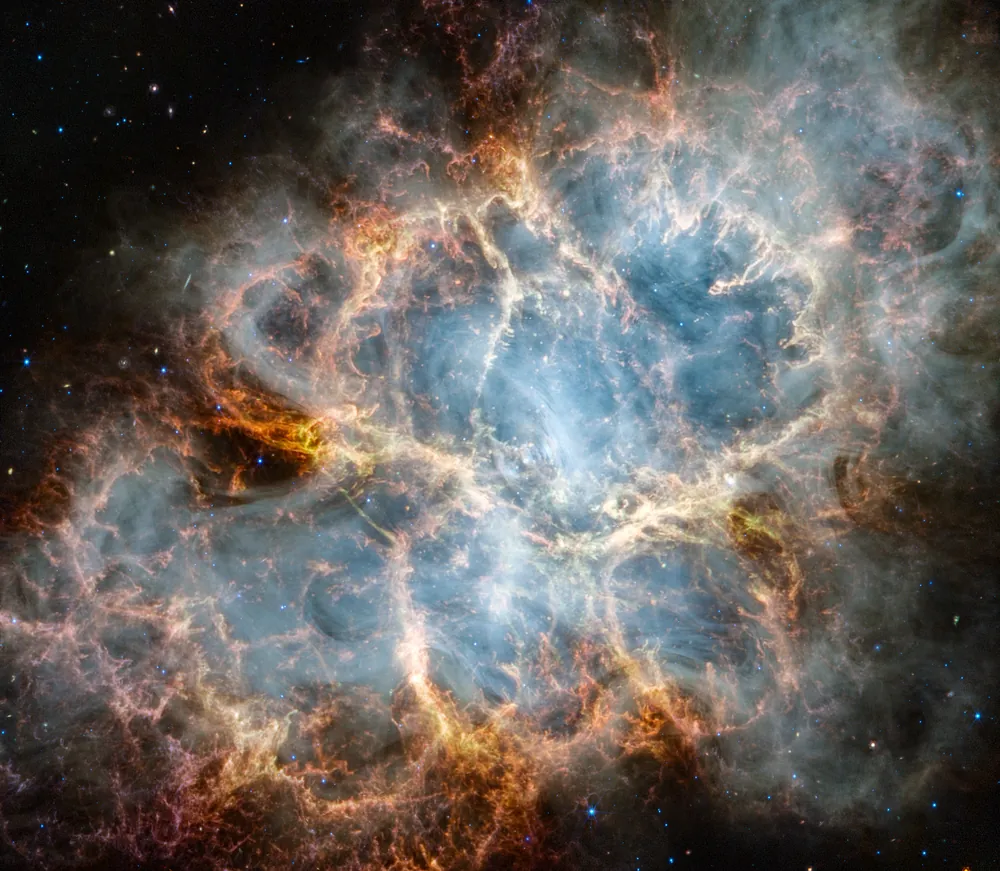
The Crab Nebula lies about 6,500 light-years away. The light that reached Earth in 1054 had been traveling for about 6,500 years, so the Song astronomers were watching the death of a star that had happened roughly 6,500 years earlier. The progenitor was a massive star. When its core ran out of fusion fuel, it could no longer hold itself up against gravity, the core collapsed, and the outer layers were blasted outward and lit up as a supernova. That debris has been expanding at about 1,500 km per second, and after nearly a thousand years it has spread into a filamentary cloud about 11 light-years across.
The pulsar found in 1968 spins once every 33 milliseconds or so, about 30 times per second. It is the neutron star left behind by the collapse. Its rapid spin and intense magnetic field keep accelerating nearby electrons to nearly the speed of light, producing synchrotron radiation, the main energy source that makes the nebula glow. The Crab still shines largely because this neutron star keeps lighting it up.
The Long Life of a Plain Record
The value of the 1054 guest star is not that it was bright or famous. It shows a complete scientific path: a plain observation written down by court astronomers nearly a thousand years ago, carried across a long gap in technology and theory, verified by modern photography, spectroscopy and radio astronomy, and then turned into a benchmark for research on supernovae, neutron stars and stellar evolution.
It is also a reminder that observation records have lasting value, even when the people writing them had no idea what they were seeing. The same holds for today's model-heavy science: first-hand records that can be tested again and again often outlive the explanations of their day.
How far is 6,500 light-years? Cosmic Horizon includes more than 500,000 Milky Way stars in the app. Zoom out from the solar system and you can see where that distance sits within the galaxy, whose disk is about 100,000 light-years across.