Ganymede: The Moon That Built Its Own Magnetic Field
A moon wider than Mercury, with its own magnetic field and a salt ocean under 150 km of ice. Hubble's aurora measurements supplied the second independent line of evidence for that buried sea.
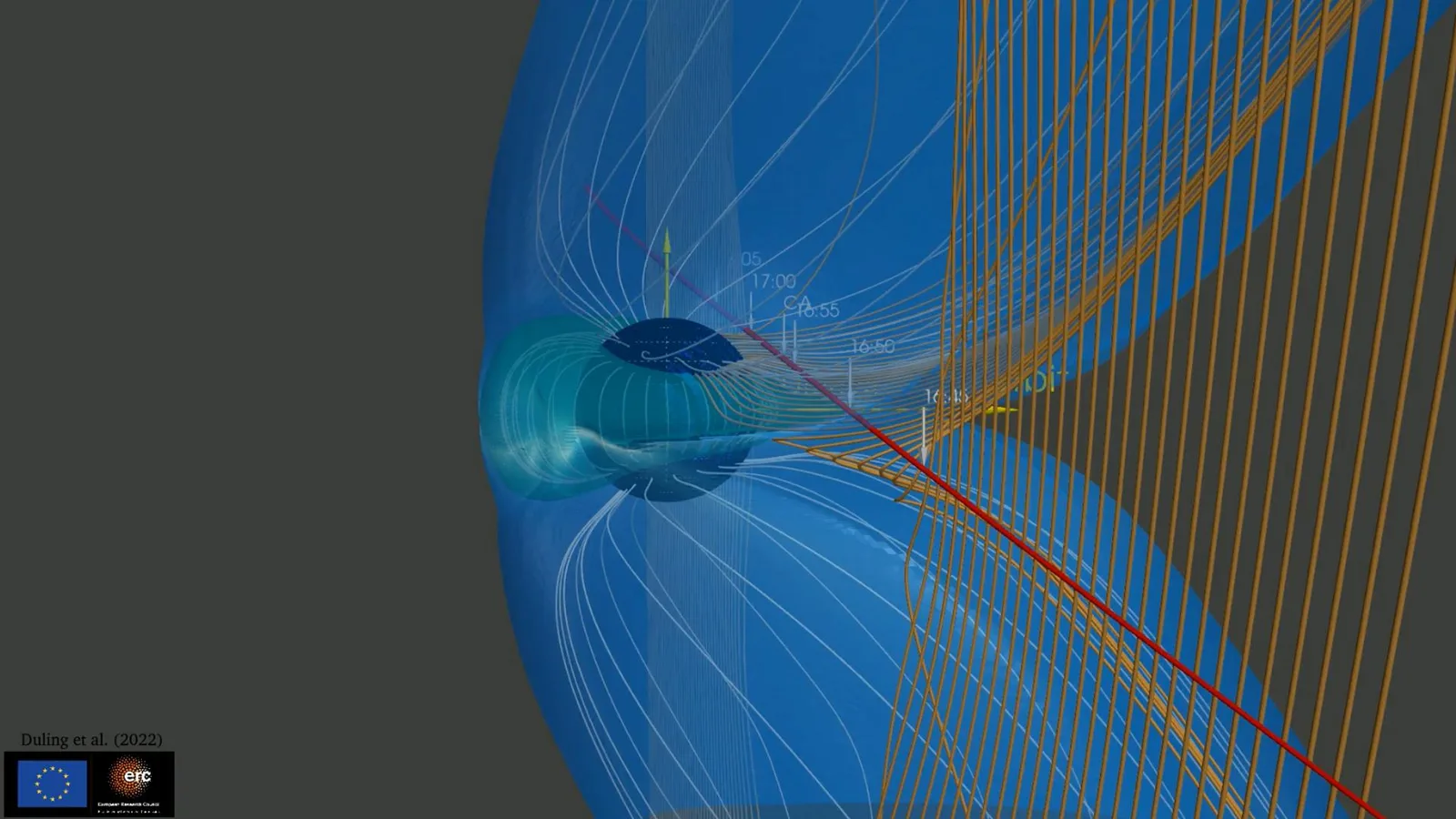
27 June 1996. Galileo is 835 km above Ganymede's surface, close enough that the moon fills the field of view and the camera can resolve individual grooves.
The magnetometer is not looking at anything. It's just recording.
And it records a set of closed field lines wrapping around a body that should not have any.
A moon with a magnetosphere. That should not happen.
First, the size problem
Galileo pointed his 20× telescope at Jupiter on 7 January 1610 and saw three stars in a line. A few nights later, four. He called them the Medicean stars, numbered Jupiter I to IV. The third one — Ganymede — is the largest of the four, and the largest moon in the solar system.
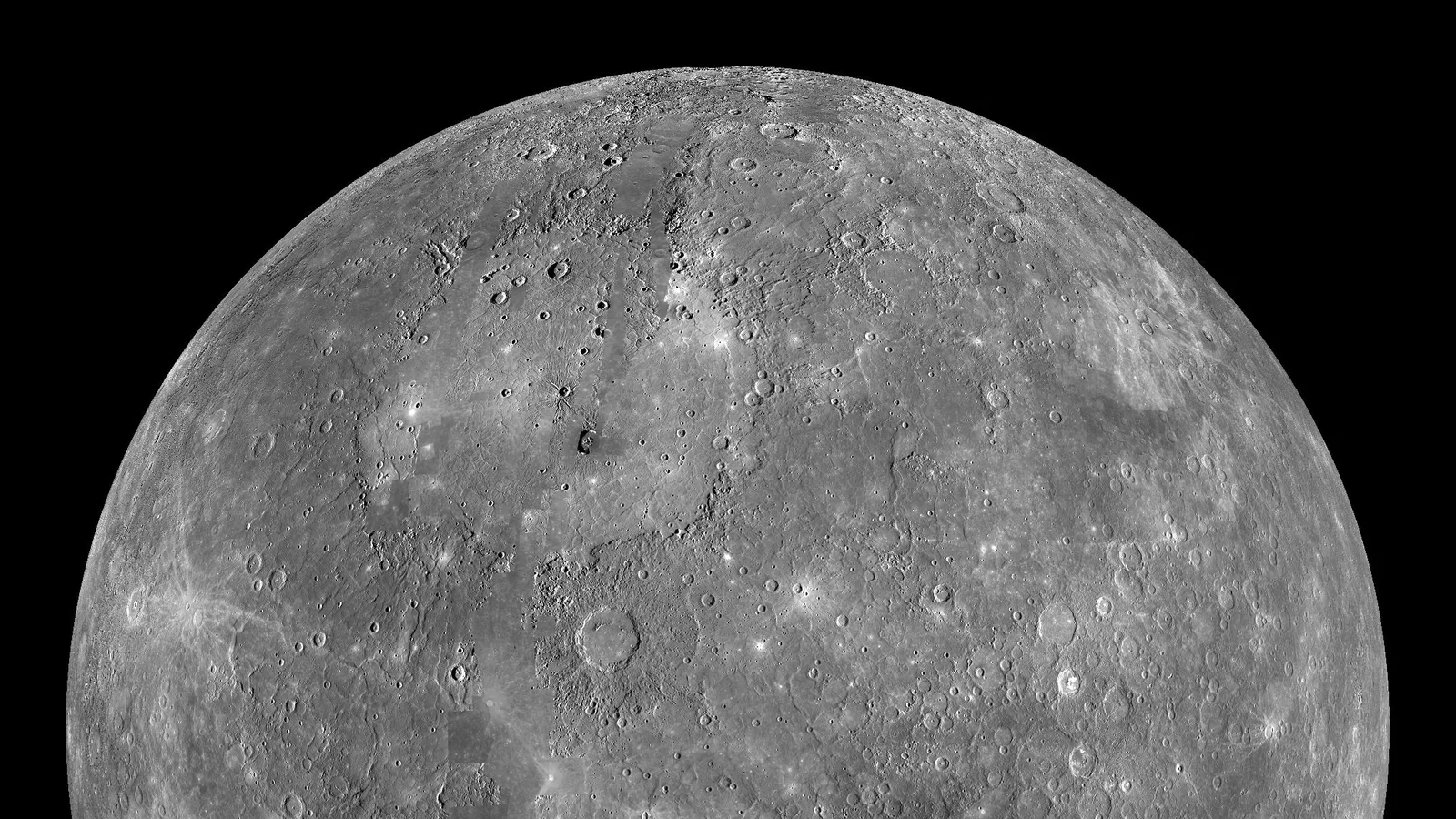
Diameter: 5,268 km. Mercury is 4,879 km. Ganymede is 8% wider than a planet.
Mass: 1.48 × 10²³ kg, a bit under half of Mercury's.
Density: 1.94 g/cm³. That number is the tell. Rock is around 3.0, water ice around 0.93. At 1.94 you're looking at roughly half ice, half rock and iron. A 5,268 km ball that is half frozen water.
Why a moon shouldn't have a field
Planetary magnetism comes from a dynamo: conductive fluid, convecting, rotating. Earth runs one in its liquid iron outer core. Mercury runs a weak one in a core that hasn't finished freezing. Jupiter runs one in metallic hydrogen.
The requirements are steep — enough mass to stay hot, enough heat flow to keep the fluid moving, the right rotation.
Moons usually fail all three. Our Moon has no global field. Its crustal magnetism is fossil. Mars had one and lost it around 4 billion years ago.
So when Galileo measured an intrinsic field at Ganymede — about 700 nanotesla at the equator, roughly one fortieth of Earth's surface field — the first reaction was to suspect the instrument. Later flybys confirmed it. The field is real, it's dipole-ish, and it carves a cavity in Jupiter's plasma that is genuinely Ganymede's own.
The best current explanation: an iron core about 500 km in radius, still crystallising. Latent heat released at the inner-core boundary drives convection, and the convection runs the dynamo.
But the awkward part: a body this small should have cooled long ago. Something is keeping the core warm — tidal heating from the Laplace resonance with Europa and Io (1:2:4), or an unusual abundance of radiogenic elements. Nobody has closed that case.
And then the aurora gave away the ocean
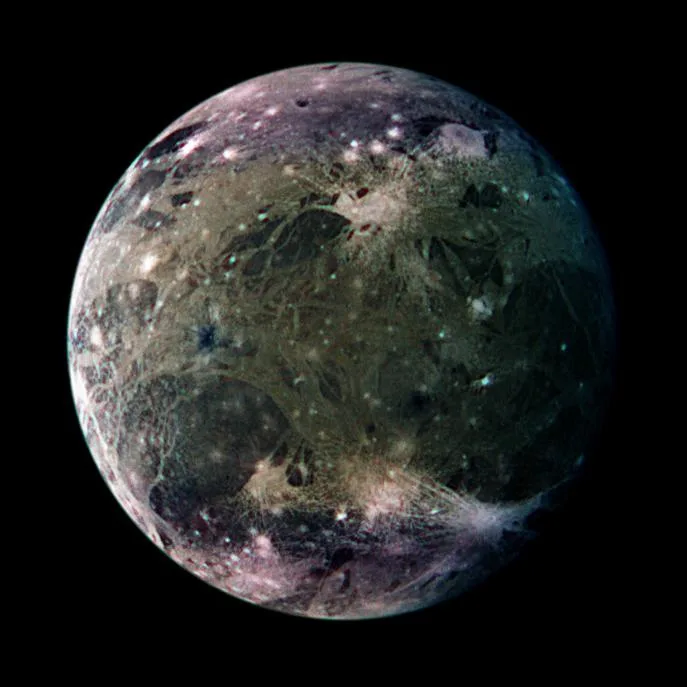
Ganymede has aurora: two ultraviolet ovals, one around each pole. They're powered by plasma bombardment, shaped jointly by Ganymede's own field and Jupiter's.
In 2015 a team at Cologne did something clever. They used Hubble's UV channel to image those ovals repeatedly through 2010–2011, then compared the positions.
The logic: if Ganymede were a rigid ball of ice and rock, the ovals would rock with the body's rotation — about 6 degrees of oscillation as Jupiter's field sweeps past every 10 hours.
If instead there's a conductive salty layer under the ice, Jupiter's rotating field induces currents in it. Those currents generate a secondary field that partly cancels Jupiter's. The ovals get damped.
Measured oscillation: about 2 degrees.
To damp 6 down to 2 you need a conductor. The fit puts it below 150 km of ice, roughly 100 km thick.
That was the second independent line of evidence. The first was Galileo's own magnetometer in the late 1990s, which saw an induced field that flipped with Jupiter's — proof of a conducting shell, but with too many free parameters to pin depth or thickness. The aurora gave a second constraint. Two separate measurements, same answer, and the case holds.
The ocean
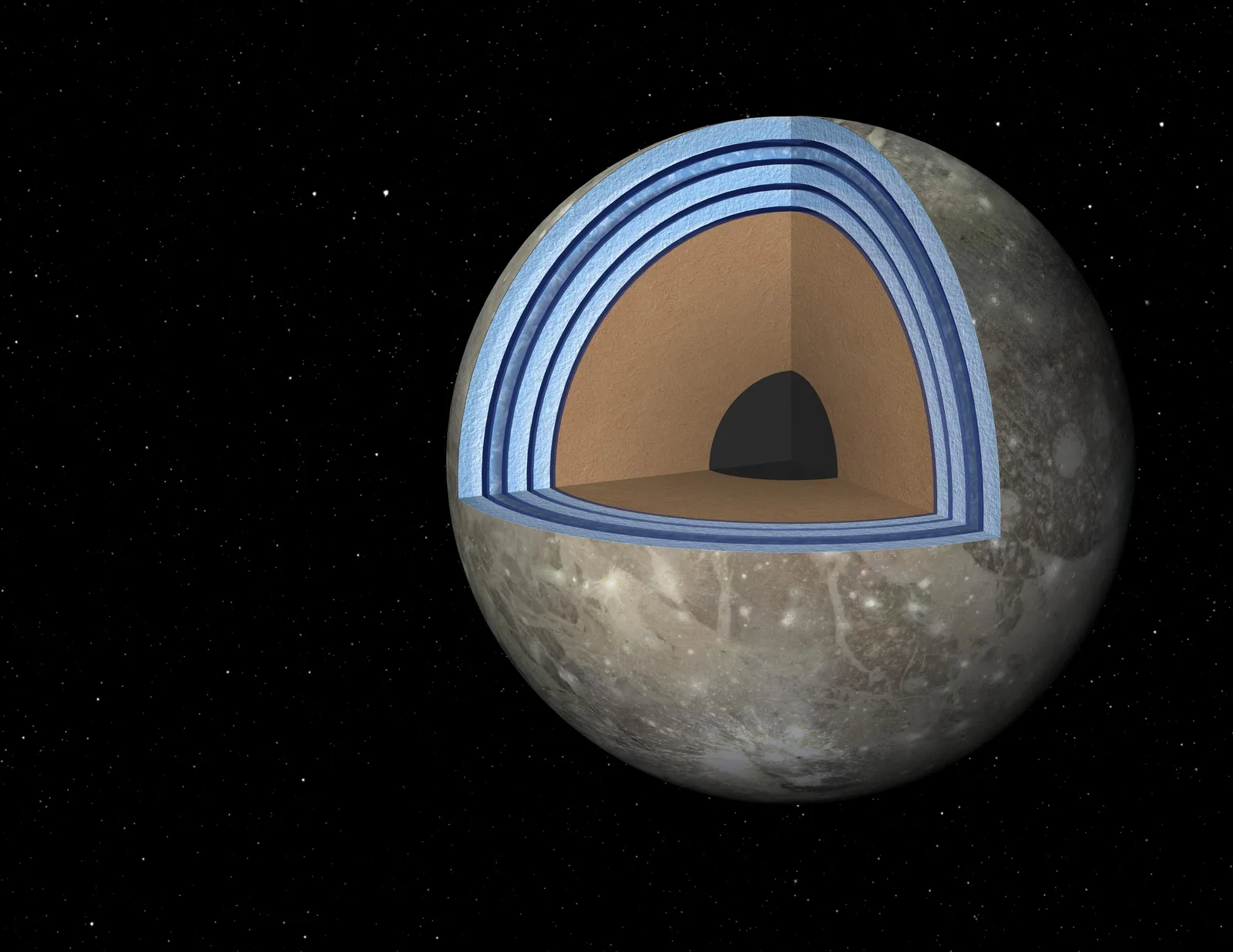
Current picture, outside in: ~150 km ice shell, ~100 km liquid brine, high-pressure ice below that, a rocky mantle, an iron core.
Total water, by model: more than all of Earth's oceans combined. The honest range across models is roughly 0.5× to 3× Earth's ocean volume — the number depends on assumed salinity and layer thickness — but the order of magnitude is not in dispute. Ganymede is one of the largest water reservoirs in the solar system.
Surface temperature: about −160 °C. The ice at the surface is hard as granite. The water is 150 km down, sandwiched between ice above and high-pressure ice below, and that pressure is part of why it stays liquid.
Why this gets its own orbiter
Ganymede stacks three rare properties on one body: an intrinsic field, a subsurface ocean, and membership in a 1:2:4 Laplace resonance. They're coupled — tidal heating warms the core, the core powers the dynamo, the field interacts with Jupiter's plasma, the plasma weathers the surface, and the surface chemistry feeds back into the ocean.
You can't untangle that from a few flybys. You need to stay.
That's JUICE. Launched 14 April 2023, Jupiter arrival 2031, with flybys of Europa and Callisto first, then Ganymede orbit insertion in 2034 — the first time a spacecraft has orbited any moon other than our own.
The payload has three instruments that matter here:
- RIME, ice-penetrating radar at 9 MHz, designed for about 9 km of penetration. It will map the shell's layering and the ice–water interface geometry.
- GALA, laser altimeter at metre-level vertical precision. It measures tidal flexure — the shell rises and falls by tens of centimetres each orbit — and the amplitude constrains shell thickness and how much liquid sits beneath.
- The magnetometer and plasma package, to characterise how Ganymede's field couples to Jupiter's plasma torus.
One honest caveat: RIME cannot see through 150 km of ice. It will not image the ocean. Nobody is going to photograph that water this decade. Everything about it will remain inference — but inference with much tighter error bars.
The judgment
Ganymede is the most underrated object in the solar system.
Public attention goes to Europa and Enceladus, because their plumes vent straight into space and that makes the story easy — sample the spray, look for organics, done.
Ganymede has no plumes. Its surface is old and geologically quiet, and every interesting thing about it is hidden in data you can't see: field vectors and ultraviolet photons.
But it's the only body where you can trace a single chain from tidal heating to core convection to magnetic field to plasma interaction to surface weathering to ocean chemistry. And it carries a natural laboratory — a small, fast-responding magnetosphere swimming through Jupiter's plasma — that is about as good a testbed for magnetic reconnection as the solar system offers.
When JUICE enters orbit in 2034, humans will spend months parked at a moon for the first time. Until then, everything we know about Ganymede rests on a few hours of flyby telemetry and a handful of Hubble images of two glowing rings.
🪐 A note from building Solar Explorer 3D: Ganymede orbits Jupiter every 7.15 days. At 1 day/sec it takes seven seconds to watch one revolution, and what you notice isn't the moon — it's how the Laplace resonance keeps Io, Europa and Ganymede locked in a repeating pattern, so the same three bodies keep meeting at the same geometric configuration. That pattern is the reason the tides keep pumping. You can browse the full solar system for free. Close-ups and landing views of the Sun, Mercury and Venus are free too, and the premium unlock covers the rest of the 60+ bodies and spacecraft. iPhone and iPad: https://apps.apple.com/app/id6752232739