The First Time Humans Heard Two Black Holes Collide
September 14, 2015. 09:50:45 UTC.
September 14, 2015. 09:50:45 UTC.
The detector in Livingston, Louisiana moved first. Seven milliseconds later, the one in Hanford, Washington — 3,002 kilometers away — moved too.
Not an earthquake. Not a truck. Not someone kicking the equipment.
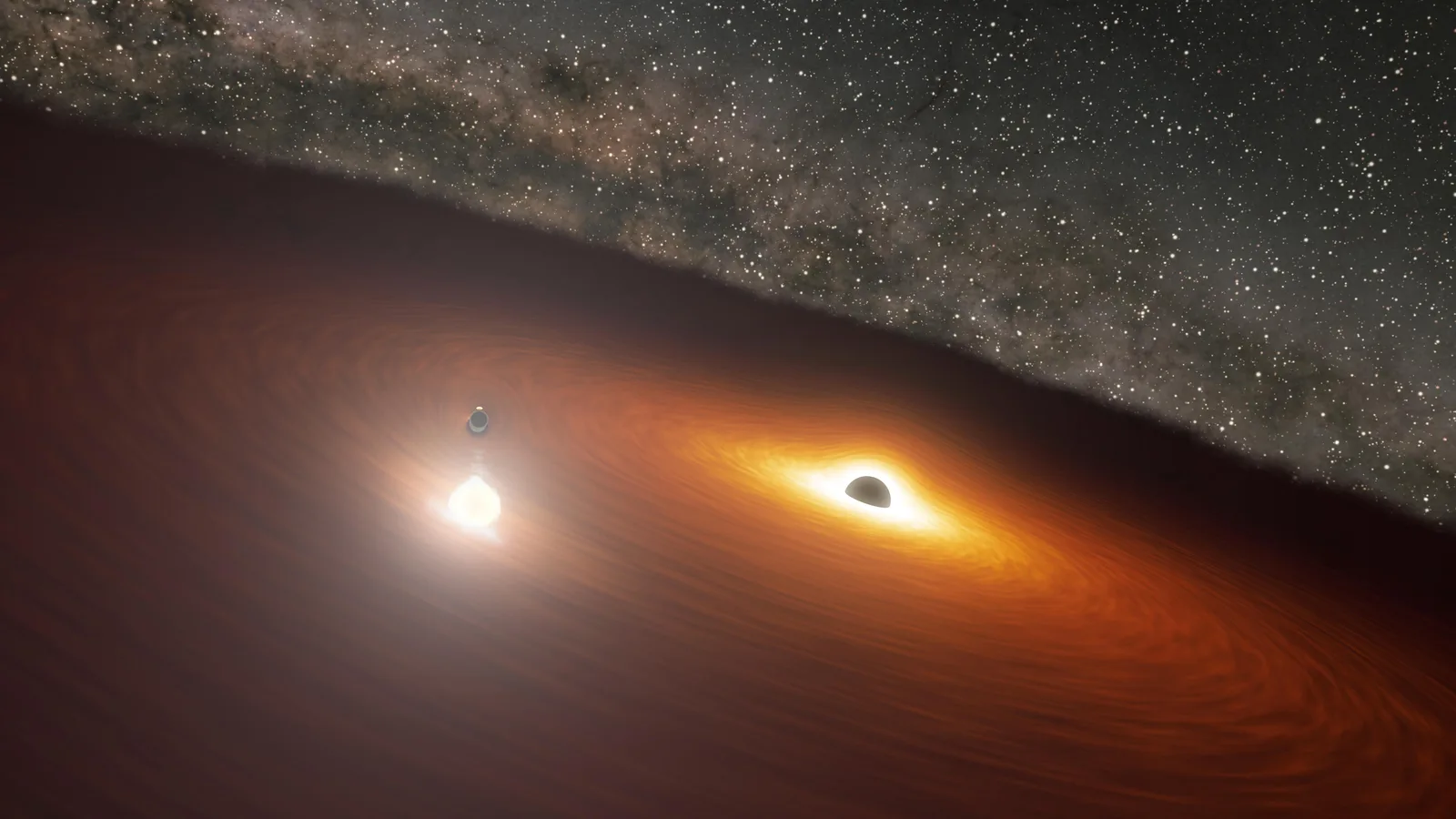
That was two black holes colliding 1.3 billion light-years away, and the entire signal lasted 0.2 seconds. In that time, a 4-kilometer steel arm changed length by about 10⁻¹⁸ meters — one-thousandth the diameter of a proton.
Humans spent a century preparing to hear that.
🌍 The seven milliseconds
Light takes 10 milliseconds to cross 3,002 kilometers. The signal arrived 7 milliseconds apart at two sites that share no equipment, no power, no data link. That delay is consistent with one wave sweeping past Earth at the speed of light from a specific direction — and it hands you the source's position for free.
A coincidence would not be this polite.
🎵 What a merger sounds like
The strain waveform is a chirp: frequency climbing from ~35 Hz to ~250 Hz in about 0.2 seconds while amplitude grows, then an abrupt cutoff, then a decaying ringdown.
That shape has an exact counterpart in numerical relativity: two compact objects spiraling inward, faster and closer, until they merge, and the remnant rings down to a stable state.
Here is the beautiful part. In the quadrupole formula, the rate at which frequency rises and the rate at which amplitude grows are not independent. Both are set by one number — the chirp mass. Measure how fast the pitch climbs, and you get the masses. Measure the amplitude, and you get the distance.
The waveform is the parameter table.
Result: 36 and 29 solar masses in, 62 out. 36 + 29 = 65. Three solar masses did not become matter — they became gravitational waves, about 5×10⁴⁷ joules, radiated in 0.2 seconds at a peak power near 3.6×10⁴⁹ watts. For that instant, it outshone every star in the observable universe combined.
🔧 Why it took forty years
Strain h is ΔL/L. At Earth, h ≈ 10⁻²¹.
4×10³ m × 10⁻²¹ = 4×10⁻¹⁸ m. And not a static displacement — an oscillation near 100 Hz.
Everything about the machine is a fight against a different noise source:
- Arm length: 4 km is the most you can build on Earth, so Fabry-Perot cavities bounce the laser ~280 times, stretching the effective path to 1,120 km
- Thermal noise: 40 kg fused-silica mirrors on multi-stage pendulum suspensions, so ground motion attenuates layer by layer
- Gas noise: the beam tube pumped to ~10⁻⁹ torr
- Shot noise: high-power stabilized lasers and power recycling
All of it running on a planet with tides, earthquakes, passing trucks, and surf.
Initial LIGO ran from 2002 to 2010. Zero detections. That was not failure — it pushed sensitivity to design spec and mapped every noise source in the budget. Then they tore it apart and built Advanced LIGO.
O1 started September 12, 2015. The signal arrived on day two.
⏱️ I love that ratio. Push measurement to the physical limit, and the universe answers within 48 hours.
🕵️ Why they waited five months
Marco Drago, an Italian postdoc in Hanover, saw it on an automated monitoring plot. His first reaction was not excitement. It was suspicion — the waveform was too clean. Clean enough to be fake.
LIGO runs blind injections: a small group can inject a simulated signal into the data stream without telling almost anyone, to test whether the analysis pipeline works and whether the collaboration will fool itself. So when a perfect signal appears, the correct prior is: someone is testing us.
Months of checking followed. Confirm no injection was scheduled or executed. Audit every auxiliary channel on both detectors. Run two independent pipelines — matched filtering and waveform reconstruction. Fit the signal across directions and polarizations.
Only when everything pointed the same way did they announce, on February 11, 2016.
I think that process is part of the result. An experiment that can resolve 10⁻²¹ doesn't earn credibility from its hardware. It earns it from how hard it tries to prove itself wrong.
🔬 What it actually settled
General relativity had already passed weak-field tests to absurd precision. What was missing was the strong-field, relativistic regime — and in the final orbits, the two black holes reach about half the speed of light with curvature changing violently.
The measured waveform matched numerical relativity across the visible band. No deviation. That doesn't prove the theory right. It means that in a parameter range previously unreachable, nobody has found it wrong.
And it confirmed something that had only been an inference from stellar evolution: stellar-mass binary black holes exist, and they merge. The masses — 36 and 29 — were read directly off the waveform. Before this, those numbers came from X-ray binaries and models, with large error bars. Now they constrain how massive stars die and how heavy a remnant they leave.
🚨 The part that opened everything
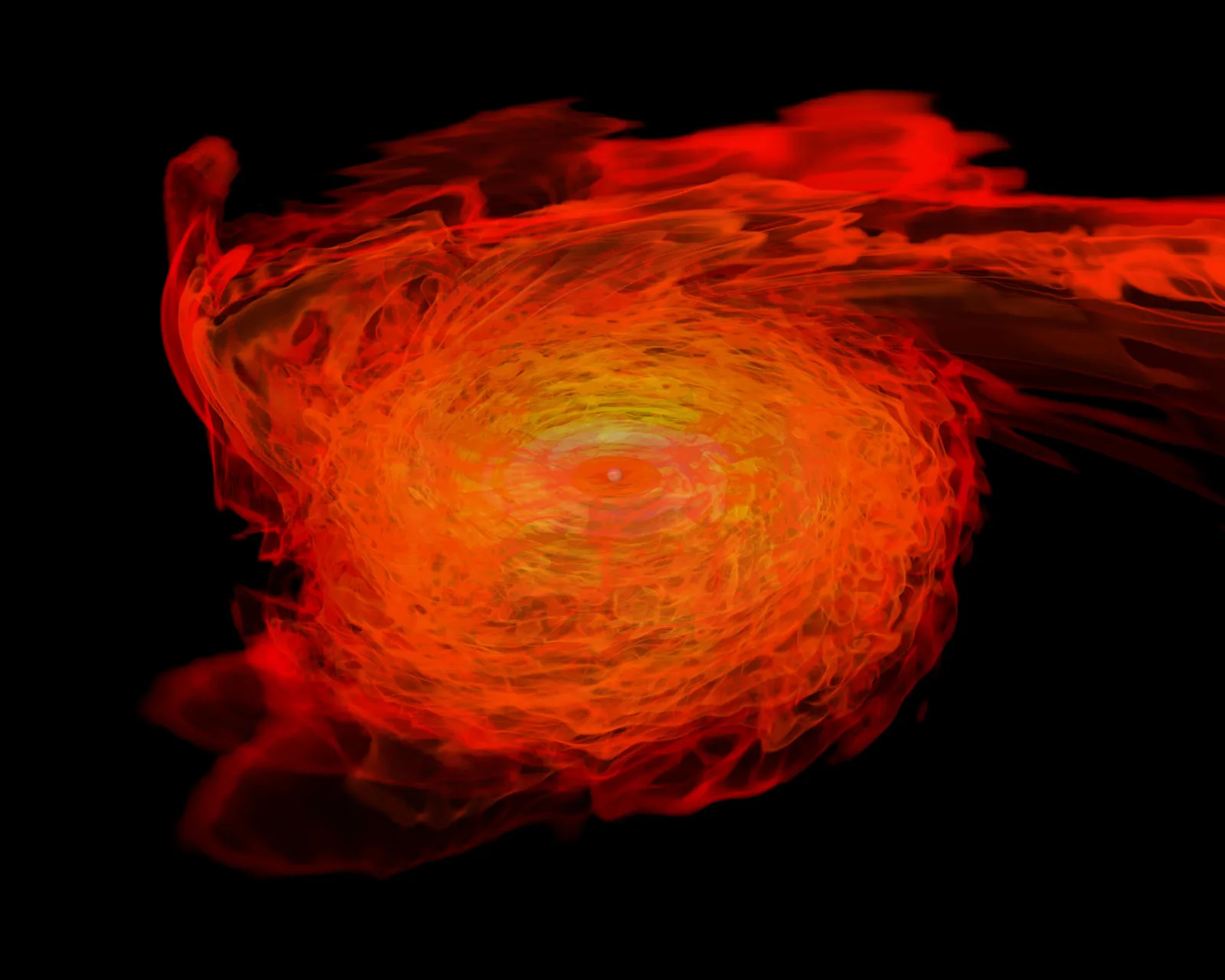
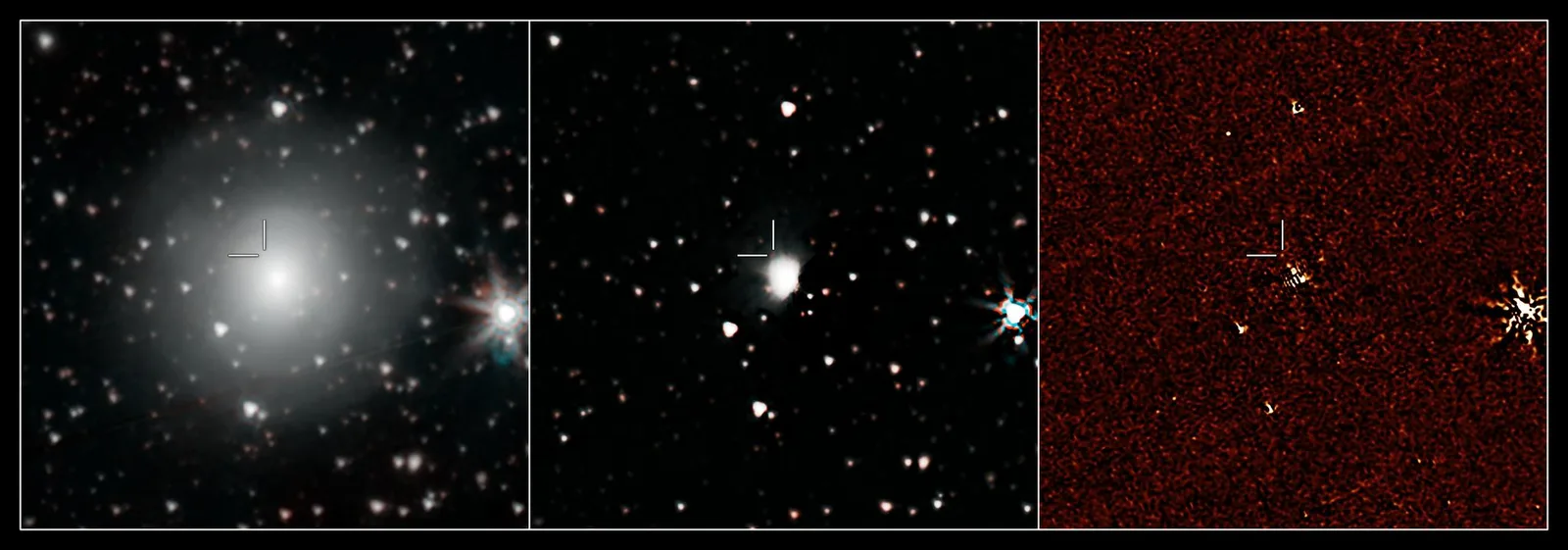
August 17, 2017. LIGO and Virgo detect a neutron-star merger, GW170817, about 130 million light-years away.
1.7 seconds later, Fermi records a short gamma-ray burst. Then dozens of telescopes find the same source in optical, radio, X-ray — a kilonova, lit by r-process nucleosynthesis.
First time humans observed one event in gravitational waves and light.
It also ran a free test: two signals left the same source, traveled 130 million years, and arrived 1.7 seconds apart. Divide that by the distance and you bound the speed of gravity against the speed of light at roughly 10⁻¹⁵. Gravity traveling at c went from assumption to measurement.
And the heavy elements. r-process is where gold, platinum, and uranium come from. The kilonova light curve gave the first direct estimate of yield per merger. The gold in a wedding ring was probably forged in a collision like that. Not a metaphor — a nucleosynthesis pathway.
🧱 The methodology, which is the real story
1916: Einstein writes down gravitational waves, then doubts anyone could ever measure them. His arithmetic was right — the strain is that small.
1974: Hulse and Taylor find the binary pulsar PSR B1913+16, whose orbital period shrinks over decades exactly as energy loss to gravitational waves predicts. Nobel 1993. Still indirect.
2015: direct detection, 99 years after the paper.
What made it happen was not a flash of genius. It was forty years of engineering: one noise source at a time, one digit of precision at a time, converting "impossible" into "very hard" and "very hard" into "routine observing run."
When Rainer Weiss wrote his 1972 internal analysis of the interferometer approach, most colleagues thought he had underestimated the difficulty. Kip Thorne and Ronald Drever pushed a parallel path at Caltech. The three designs converged. The 2017 Nobel went to Weiss, Barish, and Thorne. Drever died that March and didn't see it.
The lesson I keep: when a prediction stays unverified for a very long time, the theory is usually not wrong — the instrument just isn't there yet. The correct response is not to argue. It is to build the machine.
⏳ One more thing, from building Solar Explorer. In the app I speed time up — 1 hour/sec, 1 day/sec, 1 week/sec — because orbits only make sense to human eyes when you compress them. Gravitational-wave astronomy does the opposite: it slows time to milliseconds and shrinks length to 10⁻¹⁸ m before the universe says anything.
Same universe. We need to stretch the scale and crush it, and even then we only catch a corner of it.