Mercury: A Day Longer Than Its Year, Ice at the Poles
On March 29, 1974, Mariner 10 passed 703 km above Mercury — the first close look at the planet closest to the Sun. Fifty-two years and two spacecraft later, its magnetic field is still unexplained.
A Planet That Should Not Have a Magnetic Field
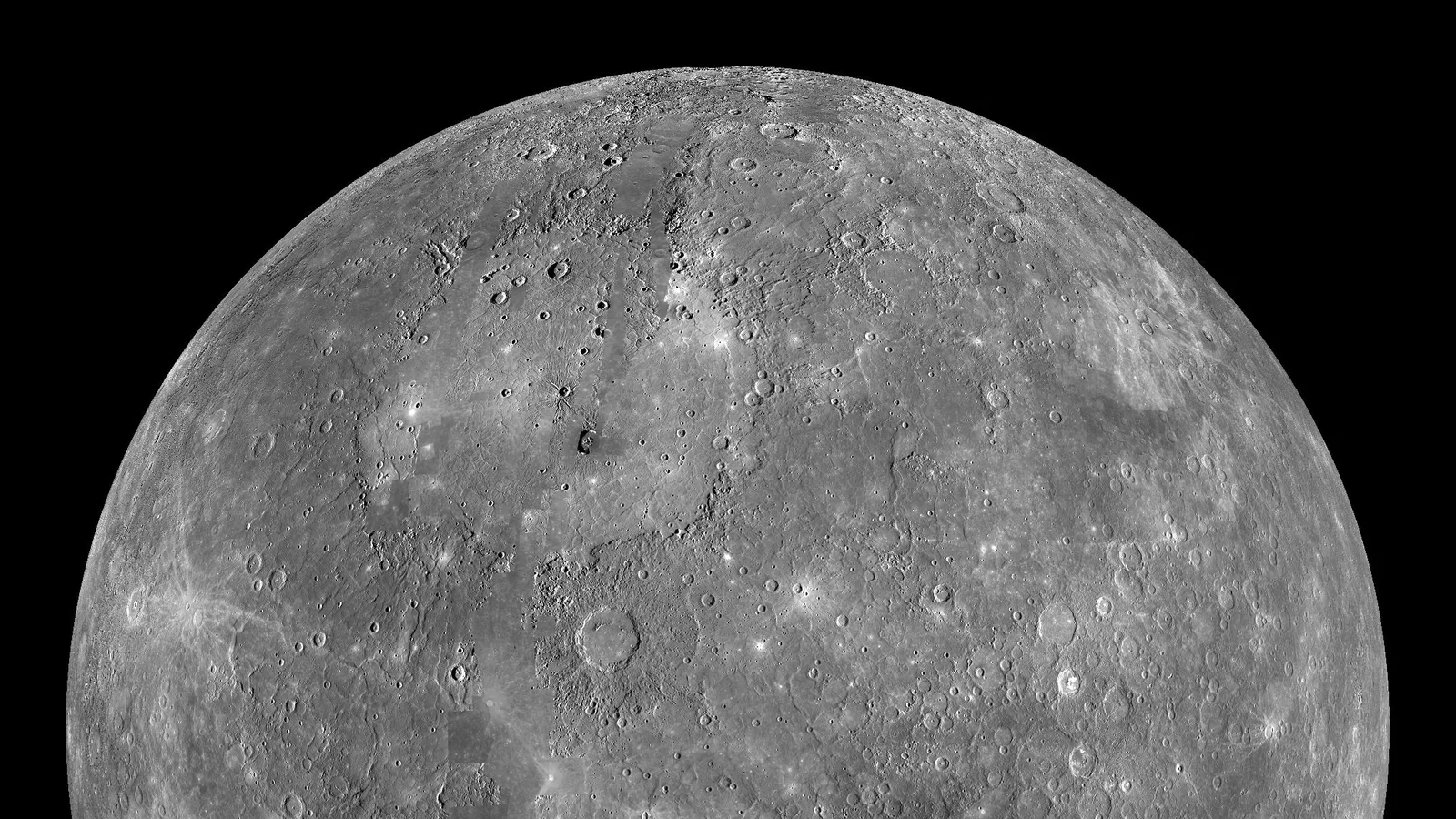
On March 29, 1974, Mariner 10 passed 703 km above Mercury. It was the first close look anyone had ever gotten at the planet closest to the Sun, and expectations were low — a cratered rock slightly bigger than the Moon, no real atmosphere, probably dead. Then the magnetometer came back with a signal 🧲
Mercury has a magnetic field. A global one, dipole-shaped, about 1% the strength of Earth's, with its axis offset some 480 km north of the planet's center. A body 4,879 km across, rotating once every 58.65 days, should have frozen solid billions of years ago. It hasn't. Fifty-two years later, nobody can fully explain why.
A Day Longer Than Its Year
Start with the part that breaks intuition first.
Mercury spins once every 58.646 days and orbits the Sun every 87.969 days — a 2:3 ratio. Two orbits, three rotations. The consequence is that a single solar day on Mercury, noon to noon, lasts 176 Earth days. Roughly two Mercurian years. The day is longer than the year, and that is not a rhetorical flourish, it's arithmetic.
It gets stranger. Orbital eccentricity is 0.2056, the highest of the eight planets. Near perihelion Mercury's angular velocity along its orbit exceeds its rotation rate, so the Sun's apparent motion reverses. Stand at the right longitude and you'd watch the Sun rise, stall, back up a bit, then resume. One sunrise takes days.
Surface temperature swings from 427°C in daylight to -173°C at night. Same patch of ground, 600°C of range. No atmosphere means no heat redistribution — the ground takes what the Sun gives and radiates it all away within hours.
427°C at Noon, Ice at the Poles
By that logic Mercury should be the driest object in the inner solar system. In 1991, ground-based radar found patches near the poles with anomalously high reflectivity — the signature of water ice. People assumed it was a calibration error. It wasn't.
Mercury's axial tilt is 0.034°. Nearly zero. So crater floors within a few degrees of the poles never see sunlight, and stay below 100 K — some below 40 K, colder than anything on the Moon. In 2012 MESSENGER confirmed the ice two independent ways: the neutron spectrometer measured hydrogen enrichment, and the laser altimeter measured reflectivity consistent with ice-bearing material. Estimated total: 100 billion to 1 trillion tonnes.
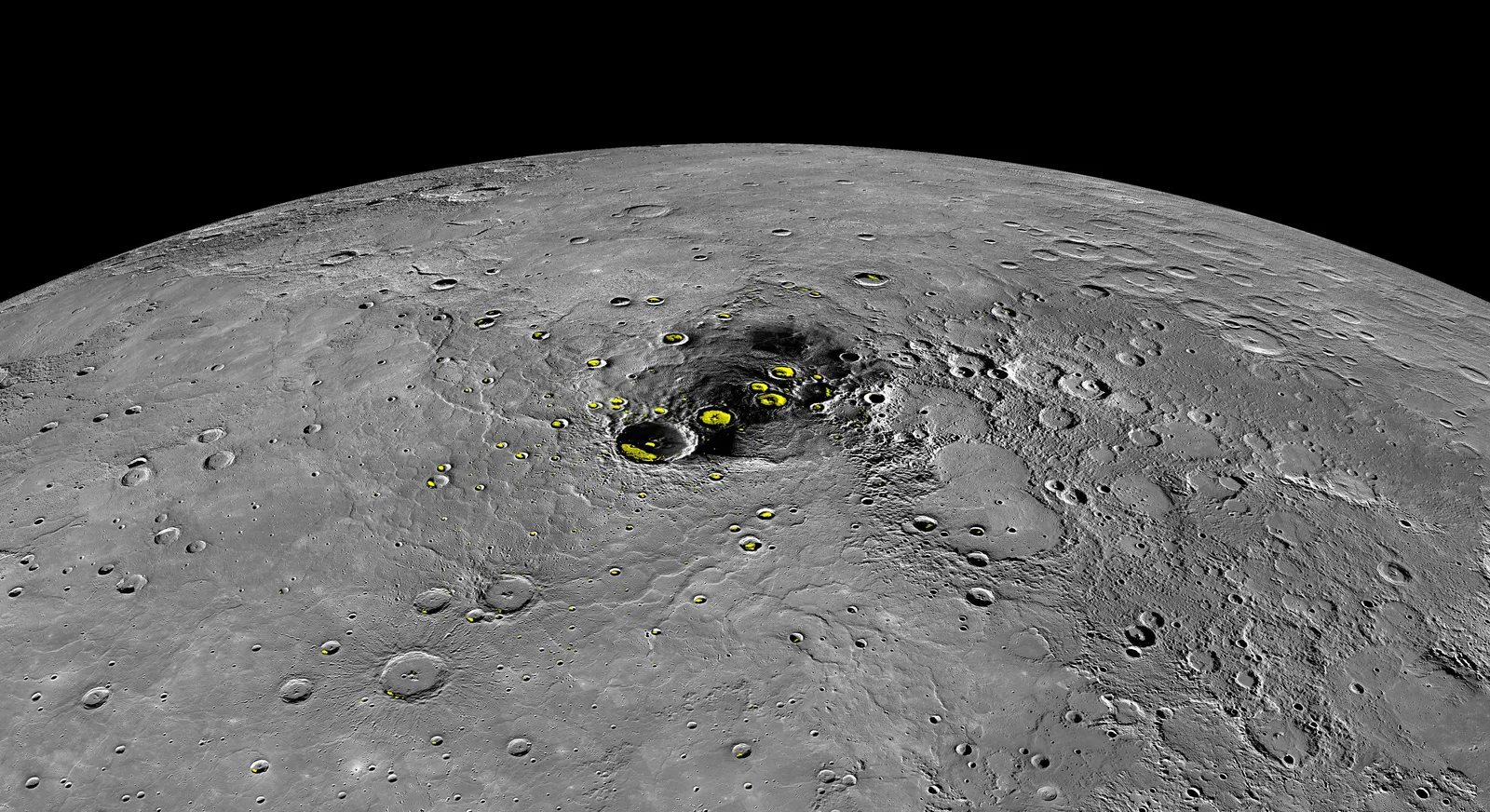
There's a dark, organic-rich layer sitting on top of that ice. Thermal imaging showed the darkest crater floors are the warmest, because they absorb sunlight best. Ice under dirt under vacuum, on a planet that melts lead at noon.
A Core That Fills 85% of the Radius
Then the structural problem, which is the one that keeps the field arguing.
Mercury's mean density is 5.43 g/cm³, second only to Earth. With a radius of 2,440 km, that requires an iron core about 2,020 km in radius — 85% of the planet's radius, over 70% of its mass, more than half its volume. Earth's core is 55% of its radius.
The standard explanation is a giant impact that stripped away most of the silicate mantle. It accounts for the core. It does not account for the surface, which is rich in sulfur, potassium and sodium, and contains less than 3% ferrous oxide. An impact violent enough to remove the mantle would have vaporized exactly those volatiles. The core says "catastrophe," the crust says "never got hot enough." Both measurements are solid.
MESSENGER added a third oddity: the surface is unusually carbon-rich. One hypothesis is a global magma ocean early on, with graphite floating to the top to form a carbon crust — which would be unique in the solar system. Unresolved.
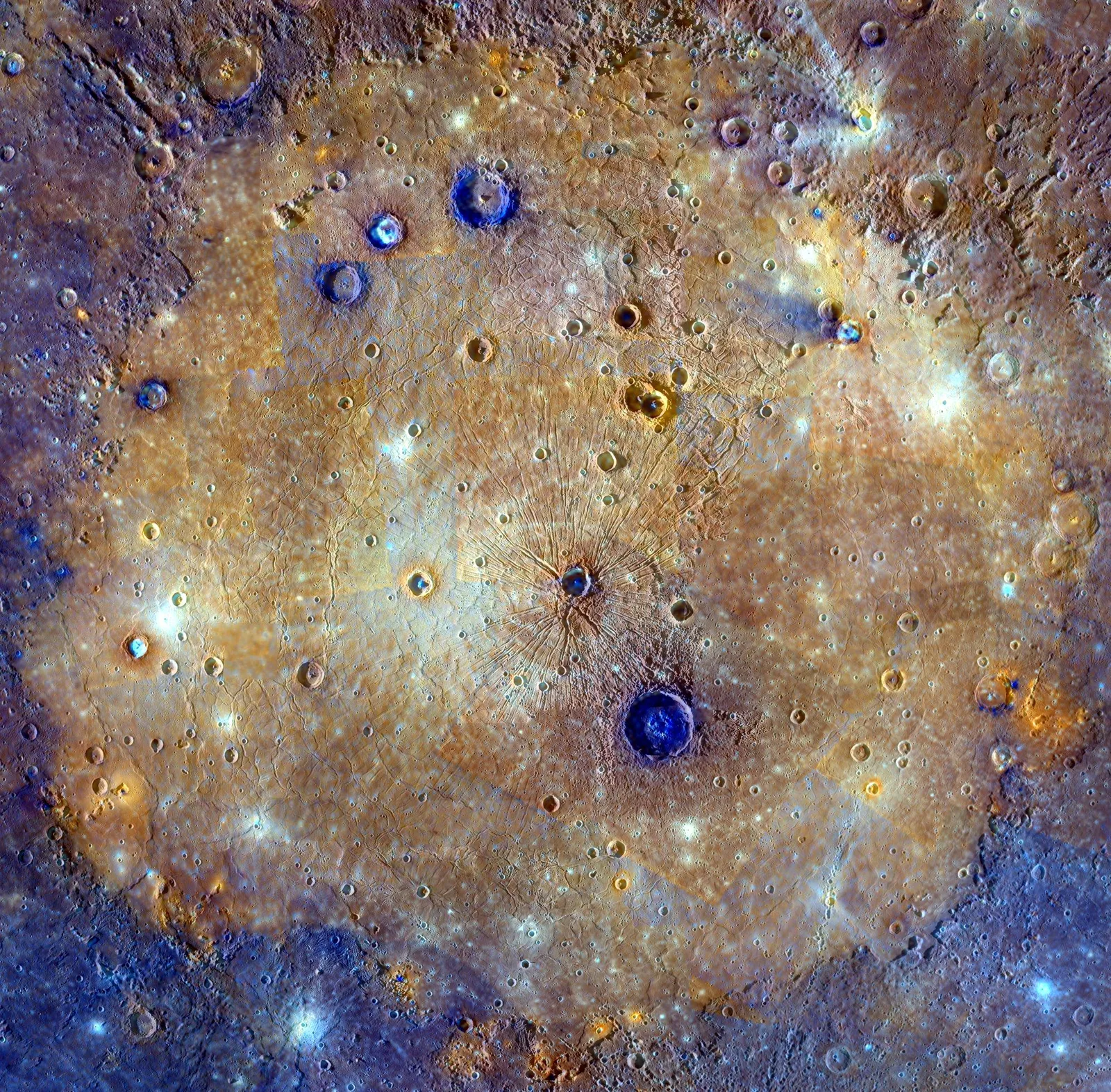
And the field itself. Where does the energy come from? In 2007, Earth-based radar measured Mercury's libration — the tiny wobble in its spin — at 1.5 to 2× what a fully solid body predicts. That number is the cleanest evidence we have that at least the outer core is liquid. Measured from 100 million km away, with a radar dish and a lot of patience.
Fifty-Two Years, Two Spacecraft
Here's the statistic that should bother you: since 1974, exactly two spacecraft have been to Mercury. Mariner 10 made three flybys and mapped 45% of the surface. MESSENGER orbited from March 2011 to April 2015 and produced most of what we know. That's it.
It isn't distance — Mercury is closer than Mars. It's the Sun. A direct trajectory accelerates the spacecraft so much that arrival velocity is unmanageable. You have to bleed off energy with repeated gravity assists, and ESA's own framing is that reaching Mercury orbit costs more delta-v than reaching Saturn.
BepiColombo launched October 20, 2018 and should enter orbit this December, with routine science starting April 2027. Its advantage is two orbiters in different orbits — ESA's MPO and JAXA's Mio — measuring the magnetic field and plasma at two points simultaneously. MESSENGER had one vantage point and had to infer spatial structure from time series. Separating "the field changed" from "the spacecraft moved" is exactly what a second point solves. It will also pin down the libration amplitude, and therefore the liquid fraction of the core, to much tighter error bars.
43 Arcseconds
One more thing, because it's the reason Mercury matters beyond Mercury.
In 1859, Le Verrier found that Mercury's perihelion precesses 43 arcseconds per century more than Newtonian gravity allows — thirteen years after he'd used the same kind of calculation to predict Neptune. That 43 arcseconds sat unexplained for 56 years. In 1915, Einstein computed 43.0. It was general relativity's first successful prediction, made before the theory had any other observational support. He wrote to a friend that he had palpitations over it for days.
Mercury is where relativistic effects get amplified to the point of being measurable, because it sits deep in the Sun's gravity well at 0.39 AU. It remains a benchmark for gravitational theory, and BepiColombo's ranging will tighten that test by one to two orders of magnitude.
A planet where the day outlasts the year, where noon melts lead and polar craters hold ice older than complex life, where the core fills most of the volume and the surface refuses to match it — and we've sent two probes in fifty-two years. It's the nearest planet to the Sun and we've barely met it 🌑
📱 In Solar Explorer, set the time scale to 1 day per second and watch Mercury's orbit. The eccentricity of 0.2056 isn't a number on a page — you can see it dive at perihelion and crawl at aphelion, and you can see why the 2:3 resonance exists at all. Switch to 1 week per second to watch it lap Earth.