The Hubble Deep Field:
Ten Days Staring at "Empty" Sky
In December 1995, Hubble spent ten days on a seemingly blank patch of Ursa Major, taking 342 exposures. The image held about 3,000 galaxies and changed how we see galaxy evolution.
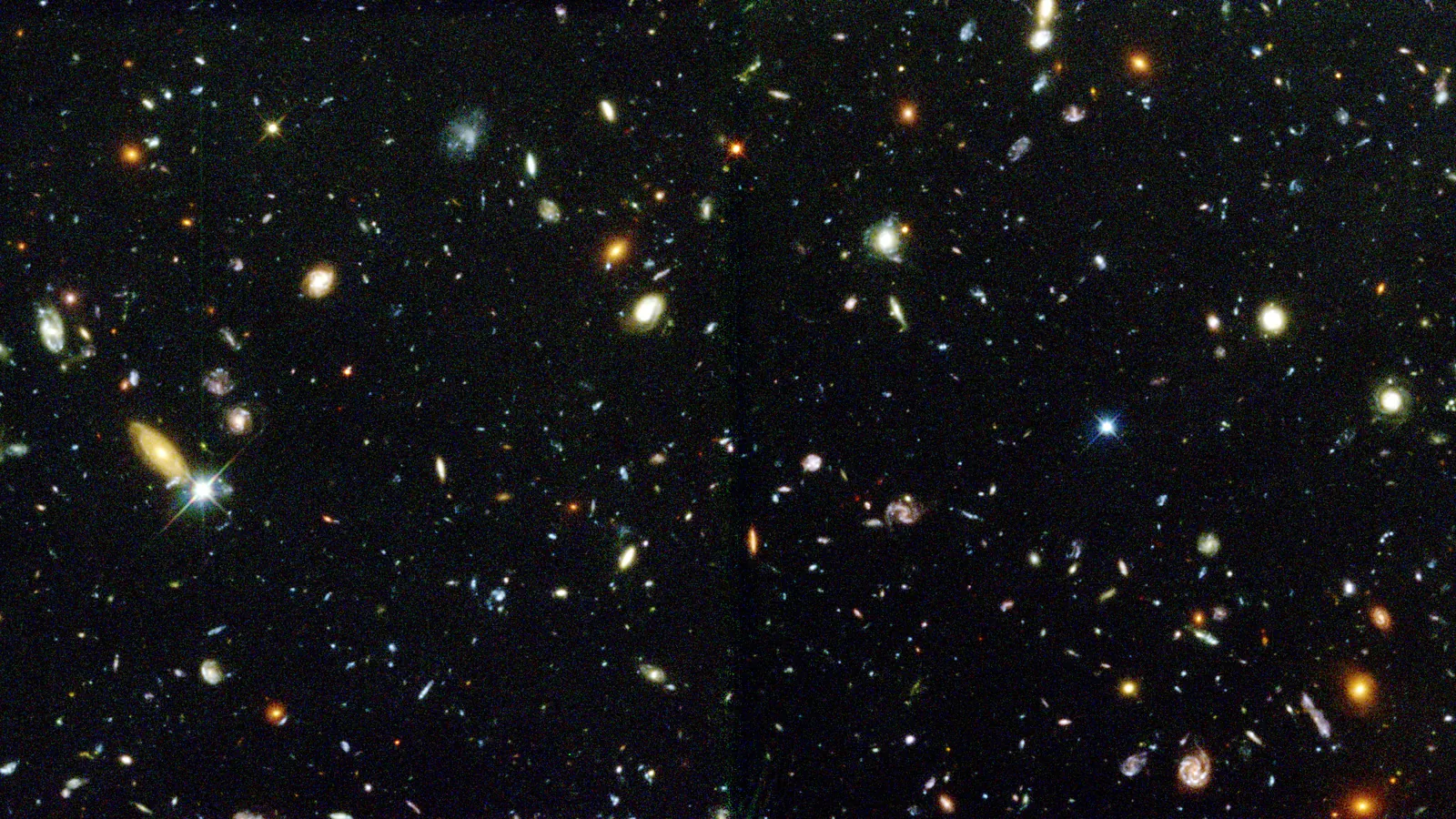
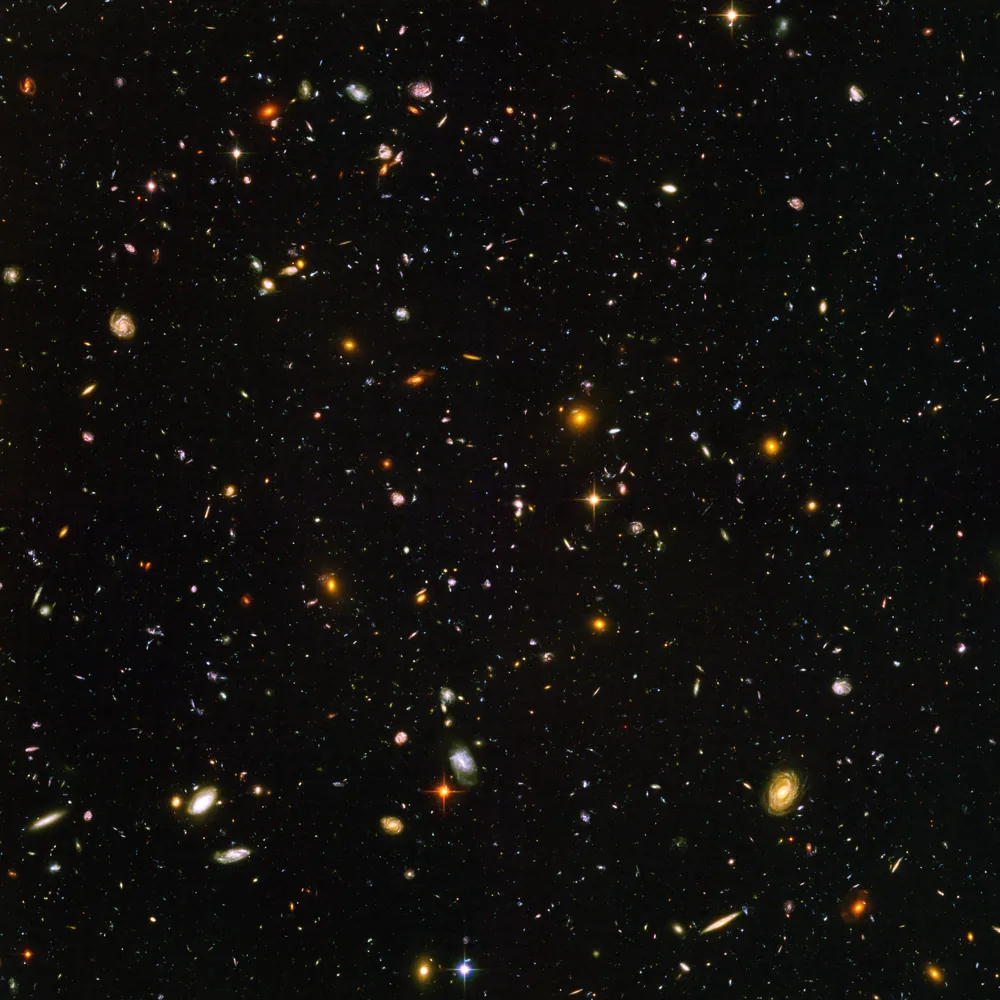
From December 18 to 28, 1995, the Hubble Space Telescope made what looked at the time like a wasteful observation. For ten consecutive days and roughly 150 orbits of Earth, it pointed at one patch of sky in Ursa Major and took 342 exposures with its Wide Field and Planetary Camera 2. The patch was about 2.6 arcminutes across, less than a tenth of the Moon's diameter and about one 24-millionth of the whole sky, the size of a tennis ball seen from 100 meters away. It was chosen to lie well away from the plane of the Milky Way, with few foreground stars and little dust in the way. When the image was released on January 15, 1996, astronomers counted about 3,000 galaxies in that "empty" spot. It became known as the Hubble Deep Field.
A Director's Gamble
Hubble time is scarce, and astronomers around the world compete for it through proposals. As director of the Space Telescope Science Institute (STScI), Robert Williams held one special lever, the Director's Discretionary Time, about 10% of Hubble's observing time. By custom it was split into small blocks for observations with clear scientific value that could not wait for the full review process.
Williams chose differently. He put a large block of it, ten straight days, on a single patch of sky thought to be blank, to test a question: is the night sky dark because objects are sparse, or because we have not looked deeply enough?
The risk was real. Many colleagues considered it a waste of Hubble time, and distant galaxies might well be too faint even for Hubble. Williams later recalled that the regular time allocation committee would never have approved such a long, risky project, but as director he could decide for himself, and if the result was that bad, he would resign.
342 Exposures, About 3,000 Galaxies
The "empty" patch turned out to hold about 3,000 galaxies.
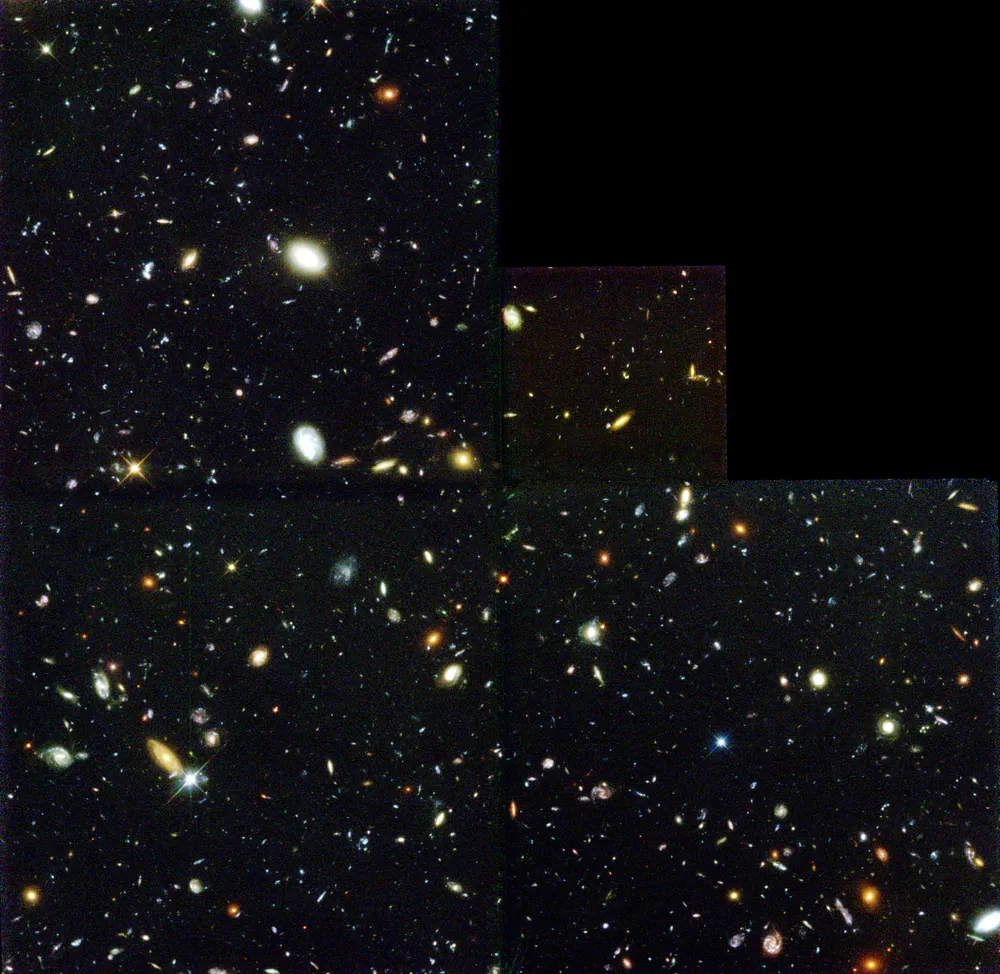
What mattered even more was what they looked like. Alongside well-formed spirals and ellipticals, the image showed many distorted, irregular galaxies caught colliding and merging. Such systems are fairly rare in the nearby universe, yet here they were packed together. That gave direct support to an idea that had largely been theoretical: in the early universe, galaxy collisions and mergers were common, and many of the orderly galaxies we see today grew into shape over a long history. The Hubble Deep Field became a key data set for studying galaxy evolution, mined and cited again and again, and many conclusions about how galaxies formed over cosmic time rest on it.
A Test of the Cosmological Principle
The cosmological principle holds that, on large enough scales, the universe looks roughly the same in every direction and from every location. Before the Hubble Deep Field, this was more a convenient starting assumption than a verified fact. The deep field offered a direct test: point the telescope in a thoroughly ordinary direction, and you still see galaxies at the same density and with the same mix of shapes.
Later observations gave the same answer. The Hubble Deep Field South (HDF-S) in 1998 repeated the experiment in the southern sky. The Hubble Ultra Deep Field (HUDF), released in March 2004 and located in Fornax, stacked nearly a million seconds of exposure and revealed about 10,000 galaxies, the faintest of them seen as they were when the universe was only about 400 to 800 million years old. A different direction and a deeper look gave the same result: look deep enough, and there are galaxies everywhere.
What Was New Was Depth, Not Direction
A common misunderstanding is that the deep field "discovered a region nobody had noticed". In fact the patch was already on star charts, and it was never literally empty. Foreground stars and Milky Way dust barely intrude there, which is exactly why it was picked. What was new was depth. Instead of looking somewhere new, Hubble piled up exposure on an ordinary patch of sky to a degree never reached before. Whether the sky looks empty depends on sensitivity, not on where you point.
Leaving Room for Risk
Looking back, the interesting part is not only the photograph but the mechanism behind it. Director's Discretionary Time carves out a channel for high-risk attempts outside the consensus-driven proposal review. Most such attempts do not produce anything spectacular. But if the system allows the occasional bet, and the stake is a small, controlled share of resources, one success can pay for all the quiet ones before it. Williams later summed it up in one sentence: "Scientific discovery requires risk."
We have grown used to allocating resources by expected results and controlled risk. The Hubble Deep Field is a reminder that the results that change what we know often come from directions that could not prove their worth in advance.
How far away are the galaxies in a deep field? In Cosmic Horizon you can zoom from the solar system out to the edge of the observable universe, passing the Milky Way, the Local Group and the Virgo Supercluster, with more than 400,000 galaxies included in the app.