Interstellar Visitors:
Three Messengers We Only Got a Glimpse Of
Since 2017 we have confirmed three objects from other star systems: ʻOumuamua, Borisov and 3I/ATLAS. Each passed through once, too fast for the Sun to hold.
We think of the solar system as a closed system, with planets, moons and asteroids each keeping to their place. But every so often something arrives from another star system. It is moving too fast for the Sun to hold onto, so it simply sweeps past and leaves forever. Before 2017, such interstellar objects existed only in theory. Planet formation should fling out huge numbers of small bodies, so the galaxy ought to be full of ejected debris, some of which will occasionally pass through other star systems. Only in 2017 did we actually see one. As of October 2026, just three have been confirmed. Each is a physical sample of another star system.
What counts as "interstellar"
The test is dynamical, not chemical. Whether a body is bound to the Sun depends on its orbital eccentricity, e. A circle has e = 0 and a parabola has e = 1. When e > 1 the path is a hyperbola: the object still has speed left over at infinite distance, and the Sun cannot pull it back. ʻOumuamua's eccentricity is about 1.2, and Borisov and 3I/ATLAS are on hyperbolic paths too. That is the hard evidence for an interstellar origin. It is not guessed from composition but calculated from the orbit.
ʻOumuamua: silent and strange
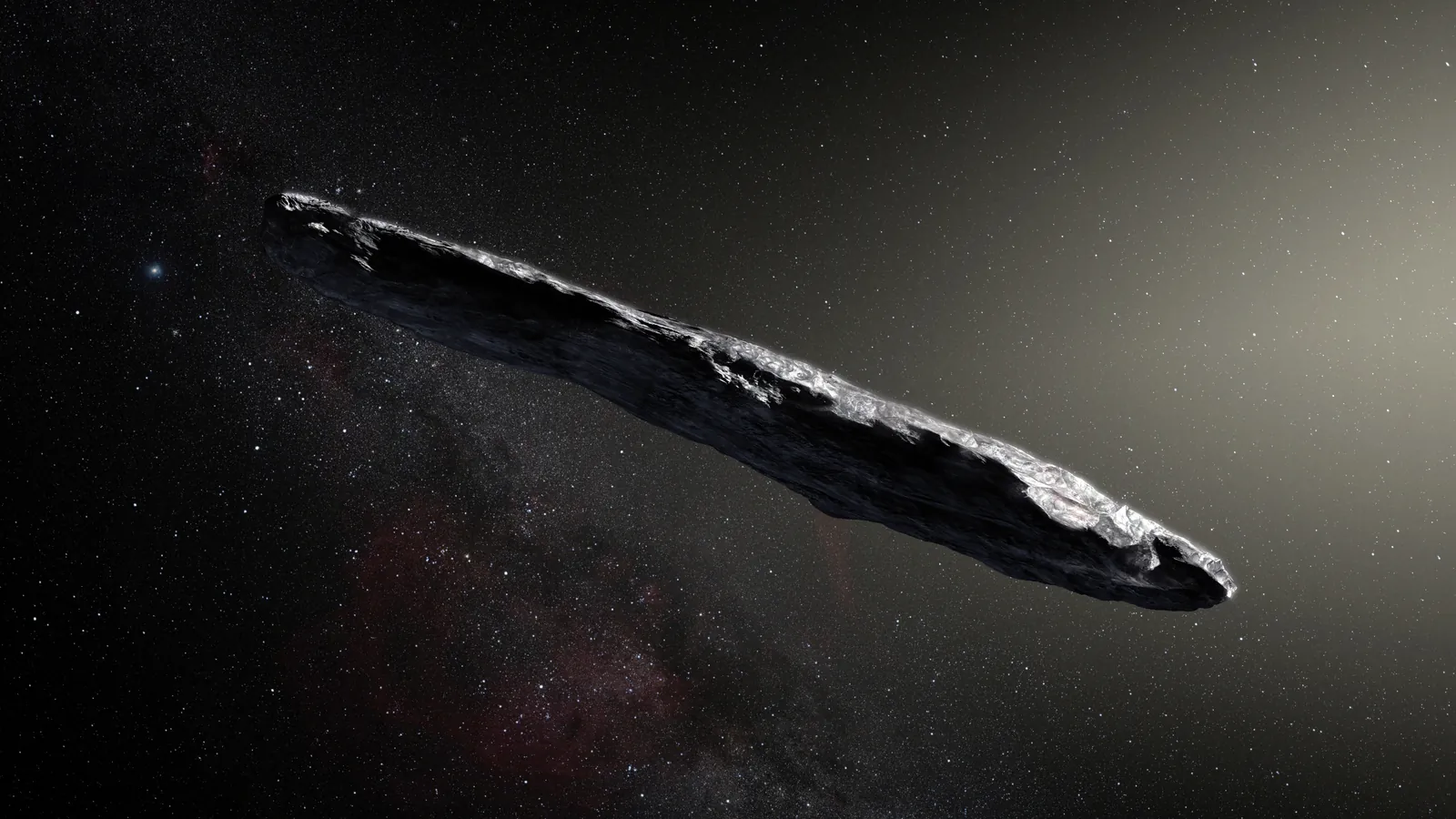
1I/ʻOumuamua was discovered on October 19, 2017, by Robert Weryk in images from the Pan-STARRS telescope at Haleakalā Observatory in Hawaii. By then it had passed its closest point to the Sun about 40 days earlier and was already heading away, leaving only a few weeks to observe it. The name is Hawaiian and means a messenger from afar arriving first.
What the observations showed was very odd. Its brightness swung sharply, which pointed to an extremely irregular shape. It may be up to ten times longer than it is wide, though some models suggest a flat pancake instead. It had no coma and no tail, a reddish spectrum, and no obvious sign of water ice or outgassing.
What really made it famous was its "excess acceleration." Precise tracking showed that as it left the Sun it was being pushed slightly away from the Sun, beyond what gravity alone predicted. Comets in our solar system show this kind of non-gravitational acceleration when ice warms, sublimates and vents gas like a tiny rocket. But no gas or dust was ever detected around ʻOumuamua. That was the paradox.
Explanations fall into roughly three groups. One says it was an ordinary comet whose activity was too faint for our telescopes. Another invokes exotic ices, such as hydrogen or nitrogen ice, that release gas without being easy to see. The most radical ideas include an artificial light sail, promoted by Avi Loeb and others but lacking independent evidence.
The explanation with the widest support today is a 2023 paper in Nature by Jennifer Bergner and Darryl Seligman. They pointed out that water ice bombarded by cosmic rays for ages produces molecular hydrogen and traps it inside. As the body warms near the Sun, that hydrogen slowly escapes, giving a push of about the right size without creating a bright coma. It explains ʻOumuamua's acceleration naturally, but it makes strong assumptions about the object's age, interior and heating history, and still needs further testing.
Borisov: a strikingly normal comet
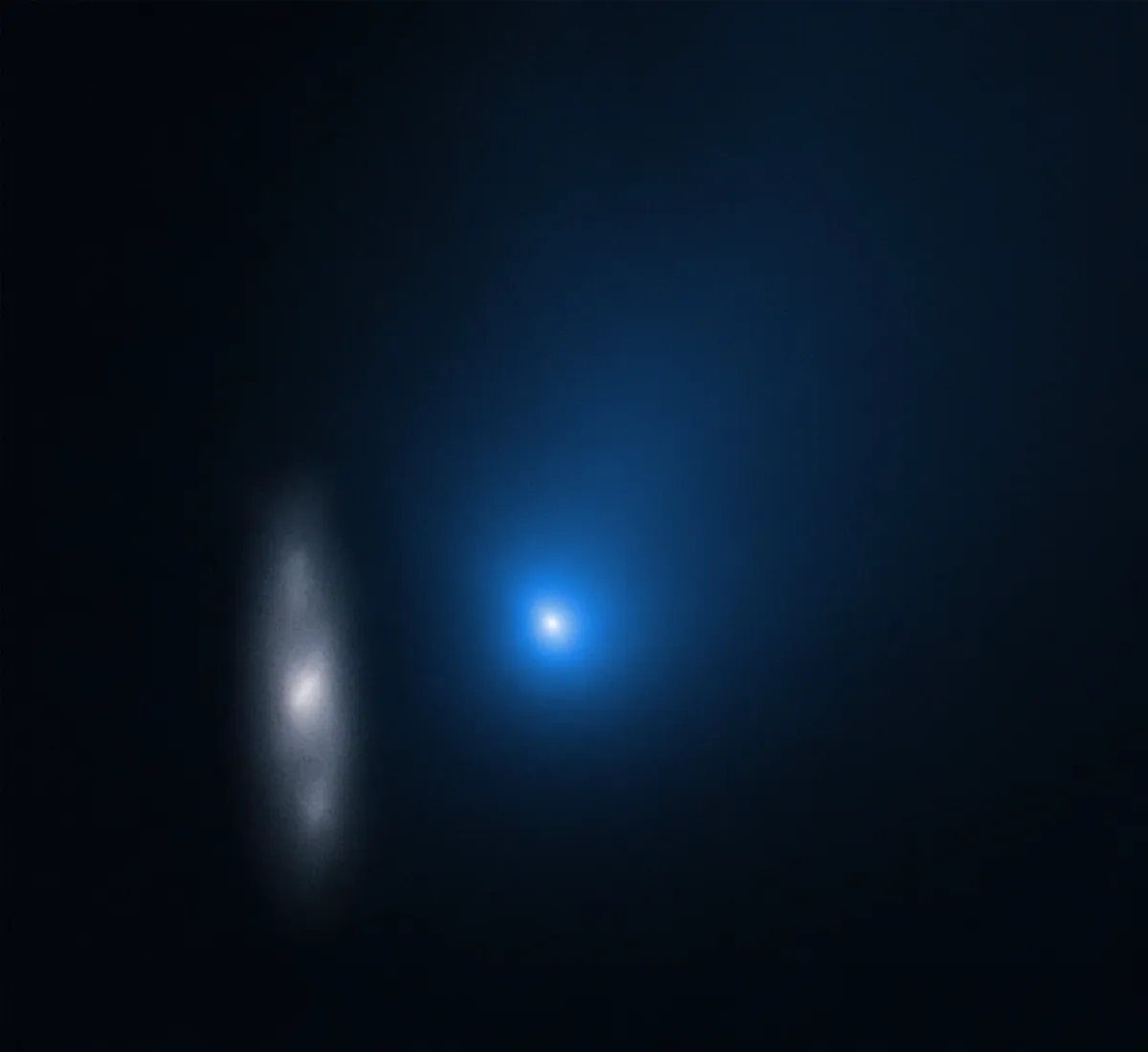
2I/Borisov was discovered on August 30, 2019, by the amateur astronomer Gennadiy Borisov in Crimea, using a telescope he built himself. It was the first confirmed interstellar comet, and a high point for amateur astronomy in this field.
Unlike ʻOumuamua, it looked very normal: a clear coma, a clear tail, and spectra showing water, cyanogen and other familiar cometary ingredients. That is exactly why it matters. It shows that a comet from another star system can be chemically quite close to the comets of our own, and that ice, dust and organic material elsewhere may not be so different from ours.
3I/ATLAS: bigger and more active
3I/ATLAS was discovered on July 1, 2025, by the ATLAS survey telescope in Chile and quickly confirmed as the third interstellar object. Based on Hubble observations on August 20, 2025, NASA estimated that its nucleus is at least 440 meters and at most 5.6 kilometers across, probably larger than either earlier visitor.
It came in from the direction of Sagittarius, toward the center of the Milky Way, moving at about 221,000 km/h when it was found. Around October 30, 2025, it passed perihelion about 1.4 astronomical units from the Sun, near the orbit of Mars, where the Sun's gravity sped it up to about 246,000 km/h. Even at its closest it stayed about 1.8 astronomical units (around 270 million km) from Earth. It posed no threat.
Unlike the first two, it was already showing a clear coma when it was discovered, and it stayed observable for much longer. Ground-based telescopes, Hubble, Webb and even spacecraft orbiting Mars all turned to look at it, so it has built up a far richer set of observations than its predecessors. It has since crossed the orbit of Jupiter and is leaving the solar system.
Three is nowhere near enough
Put the three side by side and a picture starts to form. Interstellar objects are probably not rare, but the ones we can find and observe for long enough are very few. And they differ wildly: one silent and strange, one textbook ordinary, one large and active. Each is a sample of another star system, yet we can neither stop them nor catch them. All we can do is record as much as possible while they pass.
A better question than "are they alien ships?" is why these three are so different. Are they the same kind of object at different stages, or do they come from very different star systems? Three samples cannot answer that. Once the Vera C. Rubin Observatory in Chile is surveying the sky, it is expected to find many more such visitors. ESA's Comet Interceptor is planned to launch around 2029 and wait at the Sun-Earth L2 point until a suitable target appears, and that target could be an interstellar object.
To get a feel for the space these visitors cross, open Solar Explorer, pull the view out to the orbits of the outer planets, and set time evolution to 1 week per second to watch the planets move along their orbits. 3I/ATLAS cut straight through that space at more than 200,000 km/h.