The Fuzzy Patch in Orion's Sword Is a Star Factory
Look below the belt of Orion on a clear winter night and there is a smudge where no star should be. Naked eye, it reads as one soft point. It is not one object, and it is not finished.
Look below the belt of Orion on a clear winter night and there is a smudge where no star should be. Naked eye, it reads as one soft point. It is not one object, and it is not finished.
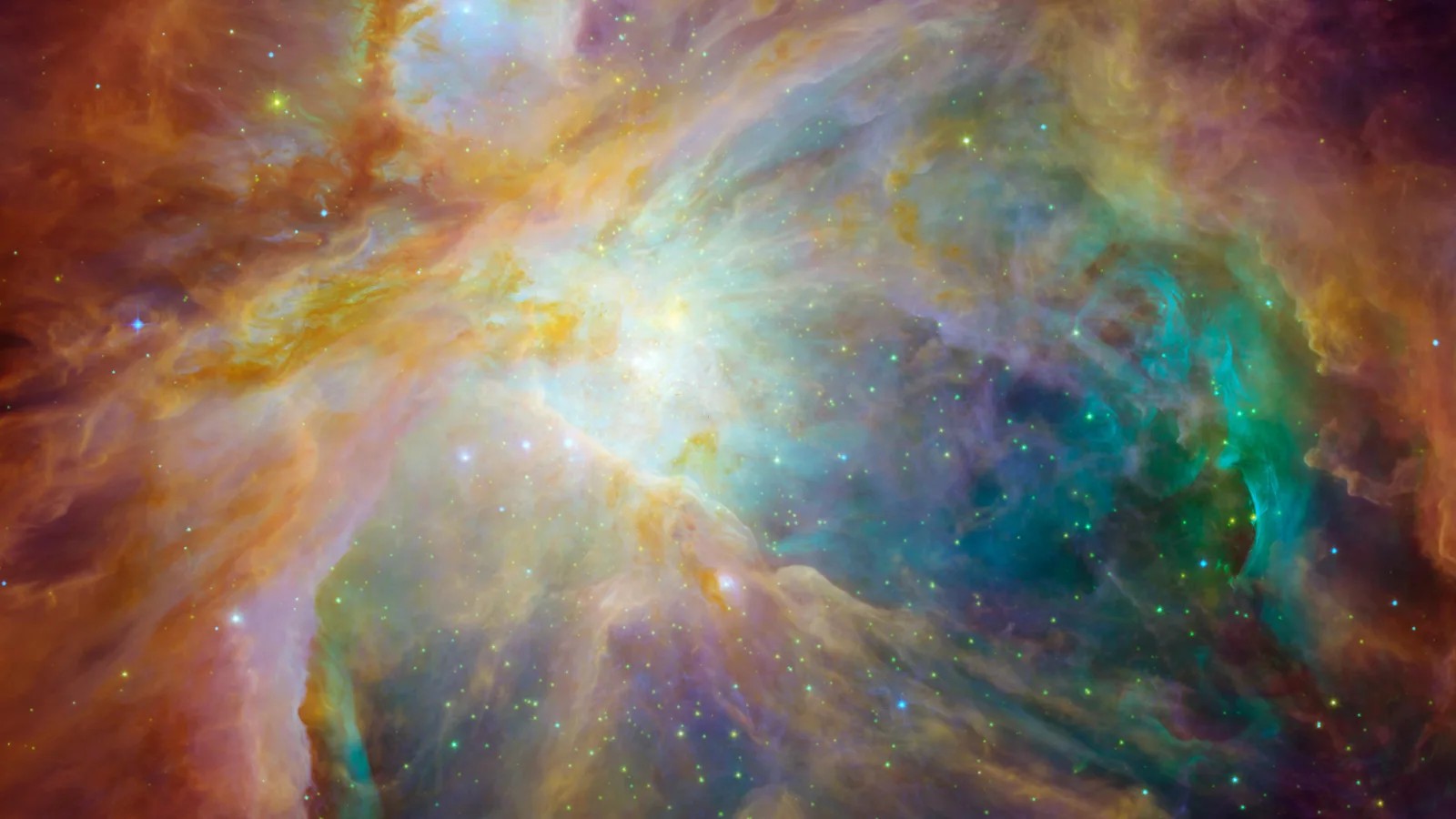
1,344 light-years away, roughly 24 light-years across, sits the Orion Nebula — M42. The light arriving tonight left in the 7th century. What it carries is a photograph of the process that made the Sun.
Three hundred years of not knowing what it was
Galileo pointed his telescope at it in 1610 and reported a cluster of stars rather than a single haze, packed too densely to count. Huygens looked again in 1656 and recorded the surrounding cloud. Neither had a category for it. The word nebula at the time meant anything that was not a point and not a planet — a catch-all, not an explanation.
Messier logged it as number 42 in 1769, mostly to stop comet hunters from wasting nights on it. William Herschel later argued the whole thing could be resolved into stars if the optics were good enough. He was half right in a way nobody could have intended: the stars are there, and the cloud is where they are being made.
In 1880 Henry Draper photographed it — a 51-minute exposure through an 11-inch refractor. The plate showed structure no drawing had caught — dark lanes, bright rims, a shape that looked less like a cloud than like something carved.
Why it glows at all
A nebula this diffuse should be invisible. The gas is thinner than any vacuum we can produce on Earth: a few hundred to a few thousand particles per cubic centimetre, against 2.5 × 10¹⁹ in the air at sea level. Sixteen to seventeen orders of magnitude emptier than the room you are sitting in.
It is visible because it is lit. At the centre of the bright region sits θ¹ Orionis C, the dominant member of the Trapezium — roughly 40 solar masses, surface temperature near 39,000 K, a few hundred thousand years old. Its ultraviolet output strips electrons from the surrounding hydrogen across light-years of space.
What follows is recombination. Free electrons find protons, fall into bound states, cascade down through energy levels, and emit at fixed wavelengths. The strongest visible line is Hα at 656.3 nanometres — red. The teal you see in photographs is mostly doubly ionised oxygen at 500.7 nm, plus a contribution from scattered starlight. The colour is not a gradient of temperature the way a star's colour is. It is a set of emission lines, and the palette depends on which lines the sensor or the eye picks up.
So M42 is an emission nebula: gas that does not shine, made to shine by a star that does. The glow is a fluorescence, and the gas is being physically excavated by the same radiation.
The Trapezium, and what the radiation does to the leftovers
The four brightest stars of the Trapezium fit inside a region smaller than the full Moon — a few thousand AU across. They are the surviving cores of a cluster that formed together and is now being blown apart by its own brightest member. θ¹ Ori C's wind and radiation pressure are dispersing the cloud that built it, which gives massive stars a self-limiting character: they clear out the nursery within a few million years of turning on.
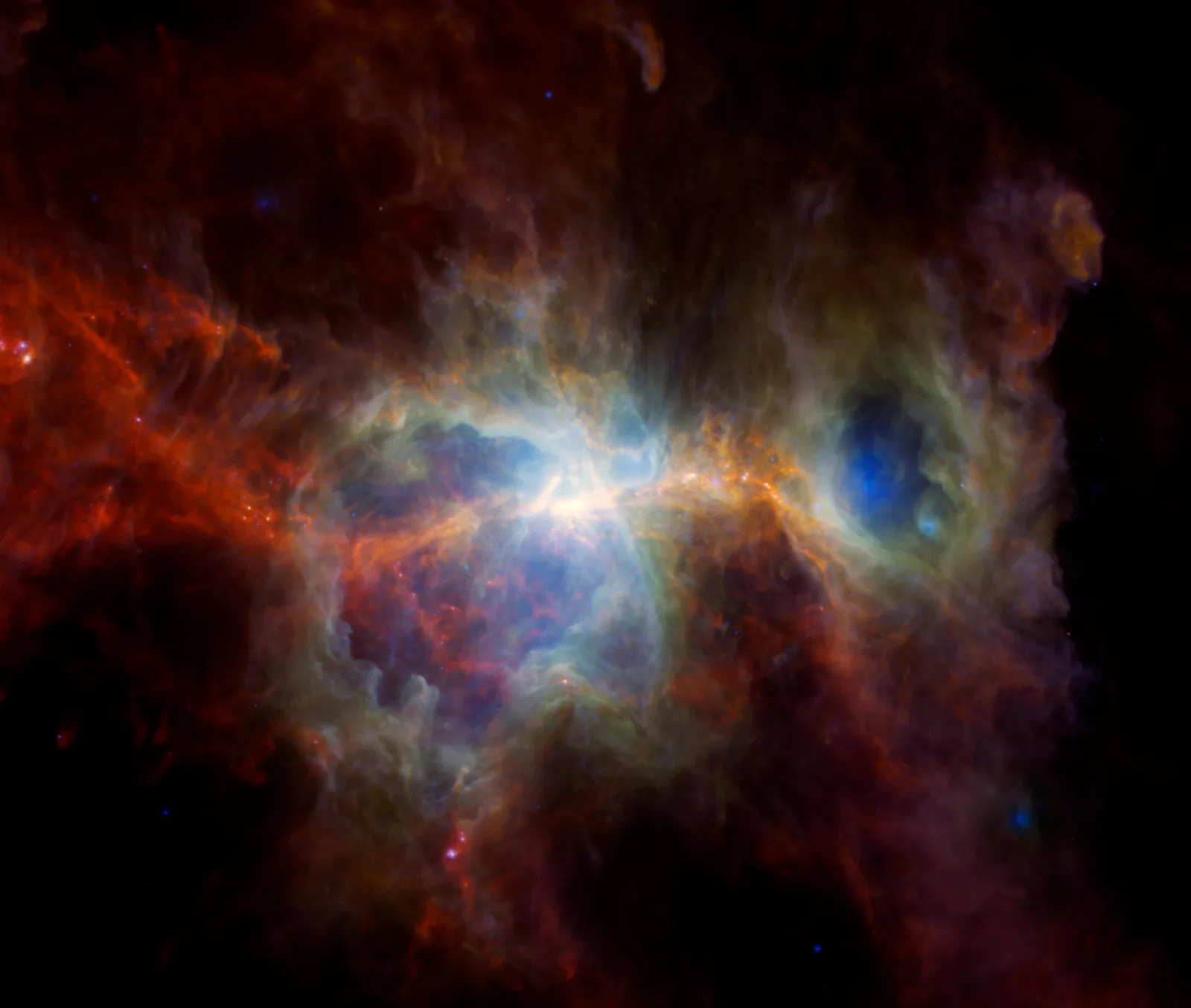
That is also why the nebula looks the way it does. It is not a stable object. It is a cavity being carved, and the bright bar and the dark lanes are the walls and the dense knots that have not yet been eroded.
1993: the disks show up
The December 1993 servicing mission corrected Hubble's optics, and the following years of imaging M42 produced the result that changed the field. Against the bright background of ionised gas, the telescope resolved more than 150 dark silhouettes — small, compact, each one a disk of dust and gas around a young star.
They are called proplyds, protoplanetary disks. Most of them are being photo-evaporated: the side facing θ¹ Orionis C is heated and stripped, so the disk develops a bright head and a tail streaming away from the massive star. They look like comets that got their geometry from a wind, not an orbit.
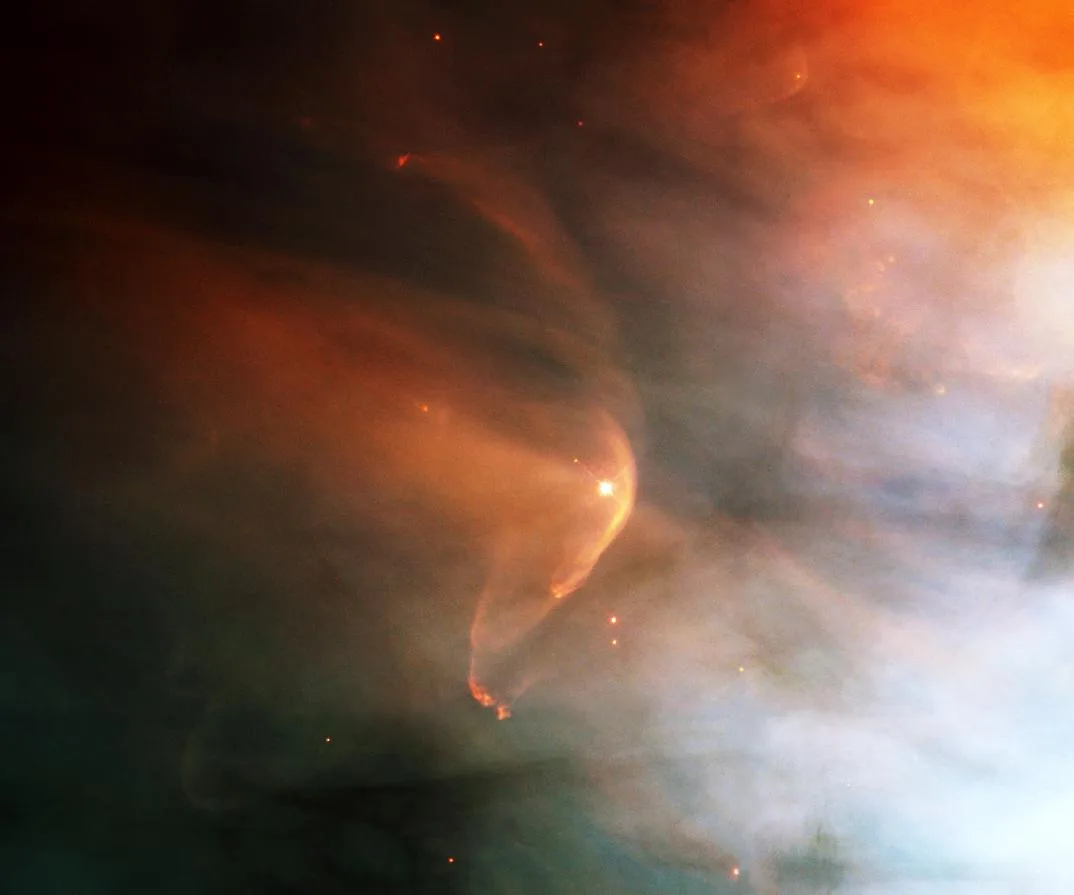
At 1,344 light-years, it is close enough to resolve those disks individually rather than as a blur. The same structures existed around the Sun 4.6 billion years ago. Here they are at a stage that lasted a few million years, caught while the ultraviolet field is still eating them.
What the numbers mean for the future
The nebula holds enough gas for thousands of stars. The cluster that emerges will be gravitationally bound for a while, then lose members as the gas leaves — the standard story for open clusters, most of which do not survive a few hundred million years.
The disks that survive the erosion have a few million years to build planets before the gas disperses. Jupiter's core had to assemble in that window. So did whatever became Earth, further in where it was warmer and the volatiles boiled off.
Everything in this frame is a snapshot of a process with a deadline.
Seeing it as an object, not an image
The problem with photographs of M42 is that they flatten it. The nebula is a three-dimensional cavity behind a foreground dark cloud, with the Trapezium at the near face of the ionised region and the molecular cloud receding behind it. The bright bar that reads as a wall in a flat image is a wall — but at an angle, and the dark lane beside it is a different structure at a different depth.
In Cosmic Horizon, M42 is placed at its catalogued distance with its catalogued extent and orientation, and you can orbit it. Seen from the front and seen from ninety degrees to the side, it is not the same object twice. The information panel reads off distance, size, and the surrounding catalogued nebulae and clusters — the 1,500-plus nebulae and 5,700-plus clusters are in there at their real positions, not arranged for composition.
🪐 A note from building Cosmic Horizon: nebula geometry comes from catalogued position, extent and position angle, so orbiting an object changes what you see rather than just the camera angle. Around 500,000 stellar positions come from Hipparcos and Gaia DR3. More than 400,000 galaxies and the large-scale structures sit at their catalogued coordinates. The free version zooms continuously from the solar system out to the edge of the observable universe, with the Milky Way scene open. A one-time unlock opens the other 33 preset scenes. iPhone and iPad, iOS 18 or later, landscape: https://apps.apple.com/app/id6761676087