Phobos:
The Moon Falling Into Mars, and the Visitor Now on Its Way
Phobos orbits just 6,000 km above Mars and is slowly falling toward it. Japan's MMX spacecraft launched on October 20, 2026, to bring a sample of it back in 2031.
In the early hours of October 20, 2026 (Japan time), JAXA's MMX spacecraft lifted off on an H3 rocket from the Tanegashima Space Center and separated cleanly about 71 minutes later, starting its journey to sample a moon of Mars. Its target, Phobos, is in a delicate position. This little moon is spiraling down toward Mars, and in a few tens of millions of years it will either strike the Martian surface or be torn apart by tides first.
A potato hugging Mars
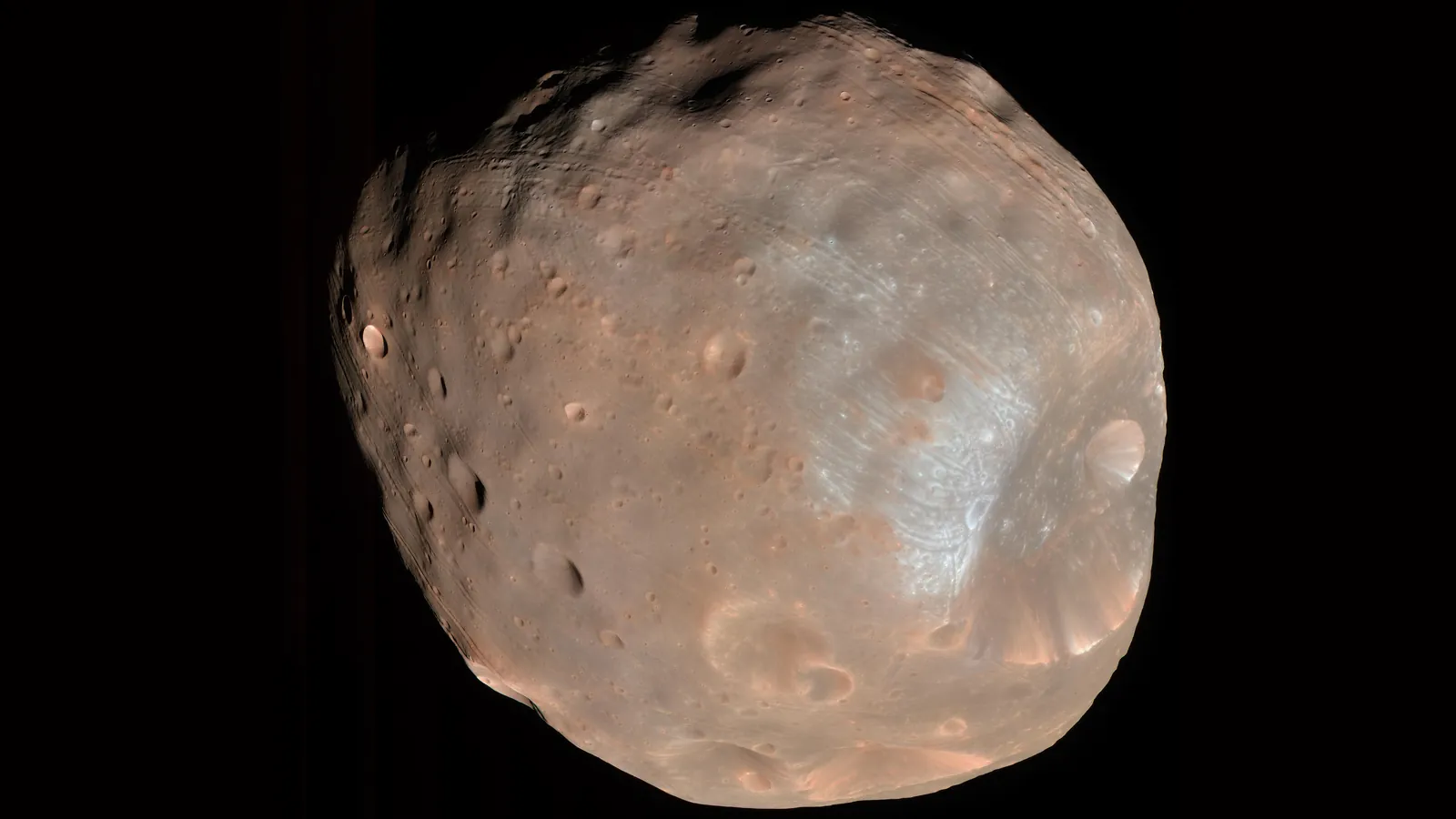
Phobos has a mean radius of about 11 km and measures roughly 27 by 22 by 18 km, with a mass of about 1.06×10¹⁶ kg. It looks like a potato with bites taken out of it. It orbits only about 6,000 km above the Martian surface, and no other known moon orbits so close to its planet. For comparison, our Moon is about 380,000 km from Earth.
Phobos circles Mars every 7 hours 39 minutes, much faster than Mars rotates (24 hours 37 minutes). So from the Martian surface it does the "impossible": it rises in the west and sets in the east, rising roughly every 11 hours, twice in a Martian day. The other moon, Deimos, orbits about 23,000 km from the center of Mars and takes 30 hours per lap, slower than the planet turns.
Phobos's Stickney crater is about 9 km across, some 40 percent of the moon's mean diameter. One explanation for the families of parallel grooves on its surface is that they are stress marks from that impact, which would mean the blow nearly shattered the moon. Its gravity is feeble too. Surface escape velocity is about 11 m/s, the same order as the top speed of an elite sprinter.
An invisible dividing line
The key to the fate of both Martian moons is the synchronous orbit. If a moon orbits faster than its planet rotates, inside the synchronous orbit, tides keep draining its orbital energy and it spirals inward. A moon outside that line is slowly pushed away instead. Our own Moon is receding from Earth at about 3.8 cm a year.
The synchronous orbit around Mars has a radius of about 20,400 km. Phobos lies inside it, and its orbit is shrinking by about 1.8 m per century. Current models say that in a few tens of millions of years it will be torn into a ring around Mars or fall into the planet. Deimos lies outside and, like our Moon, is slowly drifting away. Two moons of one planet, one falling and one fleeing, separated by a radius you cannot see.
Swift's "prediction" and the Halls
This moon also comes with a literary legend. In 1726, Jonathan Swift wrote in Gulliver's Travels that the astronomers of the flying island of Laputa had found two moons of Mars, with periods of 10 and 21.5 hours. No telescope of the day could have seen them, and the passage read as pure satire.
151 years later, during the favorable opposition of Mars in 1877, Asaph Hall at the US Naval Observatory found them for real with a 26-inch refractor: Deimos on August 12, Phobos a few days later. The story goes that Hall was ready to give up and his wife, Angeline Stickney, urged him to keep looking. The great crater on Phobos bears her maiden name.
Why go to Phobos first
Where Phobos came from is still an open question. Its spectrum resembles a dark D-type or T-type asteroid, which suggests a captured interloper. But its orbit is almost perfectly circular and lies flat in Mars's equatorial plane, and captured asteroids usually end up on stretched, tilted orbits. Turning one into today's Phobos is very hard. The rival idea is that Phobos formed from debris blasted into orbit when a large body struck early Mars, the same logic as the giant impact theory for our Moon. The spectrum says asteroid, the orbit says native moon, and only a sample in a laboratory can settle it.
There are three practical reasons to sample Phobos before the Martian surface. First, Phobos has so little gravity that landing is more like docking, which avoids the whole chain of entering an atmosphere, landing and launching again from Mars. Second, if it is a captured asteroid, the sample is a pristine record of the early solar system. Third, impacts on Mars throw rock into space, and some of it lands on Phobos. Its soil very likely contains material from Mars itself, so sampling Phobos may bring home a bit of Mars along the way.
MMX's itinerary
MMX (Martian Moons eXploration) is led by JAXA with NASA, the French space agency CNES, the German Aerospace Center DLR and ESA. The plan is to enter Mars orbit in August 2027 and move about a month later into a quasi-satellite orbit around Phobos for a close survey. In 2029 it will release IDEFIX, a small rover built by France and Germany, then land on Phobos itself once or twice to collect at least 10 g of material, fly past Deimos, and return its sample capsule to a landing in Australia in 2031. The approach follows directly from Hayabusa and Hayabusa2. If all goes well, MMX will be the first spacecraft to orbit Phobos, the first to sample its surface, and the first to return to Earth from the Mars system.
Planetary science keeps teaching the same lesson: bringing samples home is a direct way to rewrite textbooks. Apollo's moon rocks reshaped the history of the Moon, and Hayabusa2's grains from Ryugu changed how we think about asteroids. Whichever origin the Phobos sample points to, it will turn these two small moons from an unsolved case into an archive. And if Martian ejecta really is mixed into the soil, we will have carried out an indirect Mars sample return ahead of schedule.
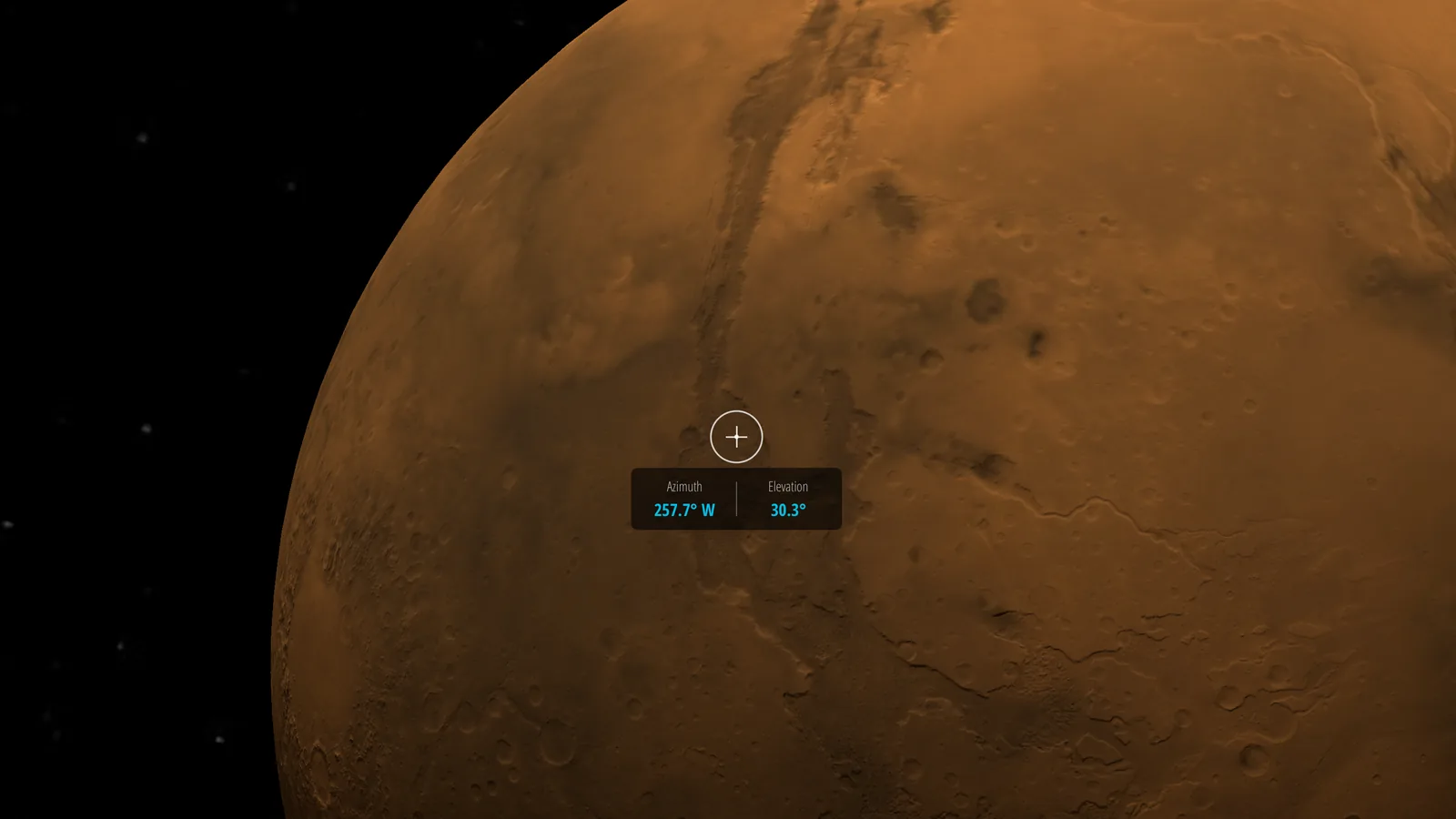
In Solar Explorer you can use the landing view to stand on Phobos and look at Mars. Mars is visible only from the side facing it, where it spans about 42 degrees, more than 80 times the width of the full Moon as seen from Earth. Set time evolution to 1 hour per second and Phobos completes an orbit in under 8 seconds.