On Titan, Saturn Fills the Sky and You Can't See It
On 14 January 2005, Huygens came down through Titan's atmosphere and landed on a plain of water-ice pebbles. The ground had the consistency of wet sand.
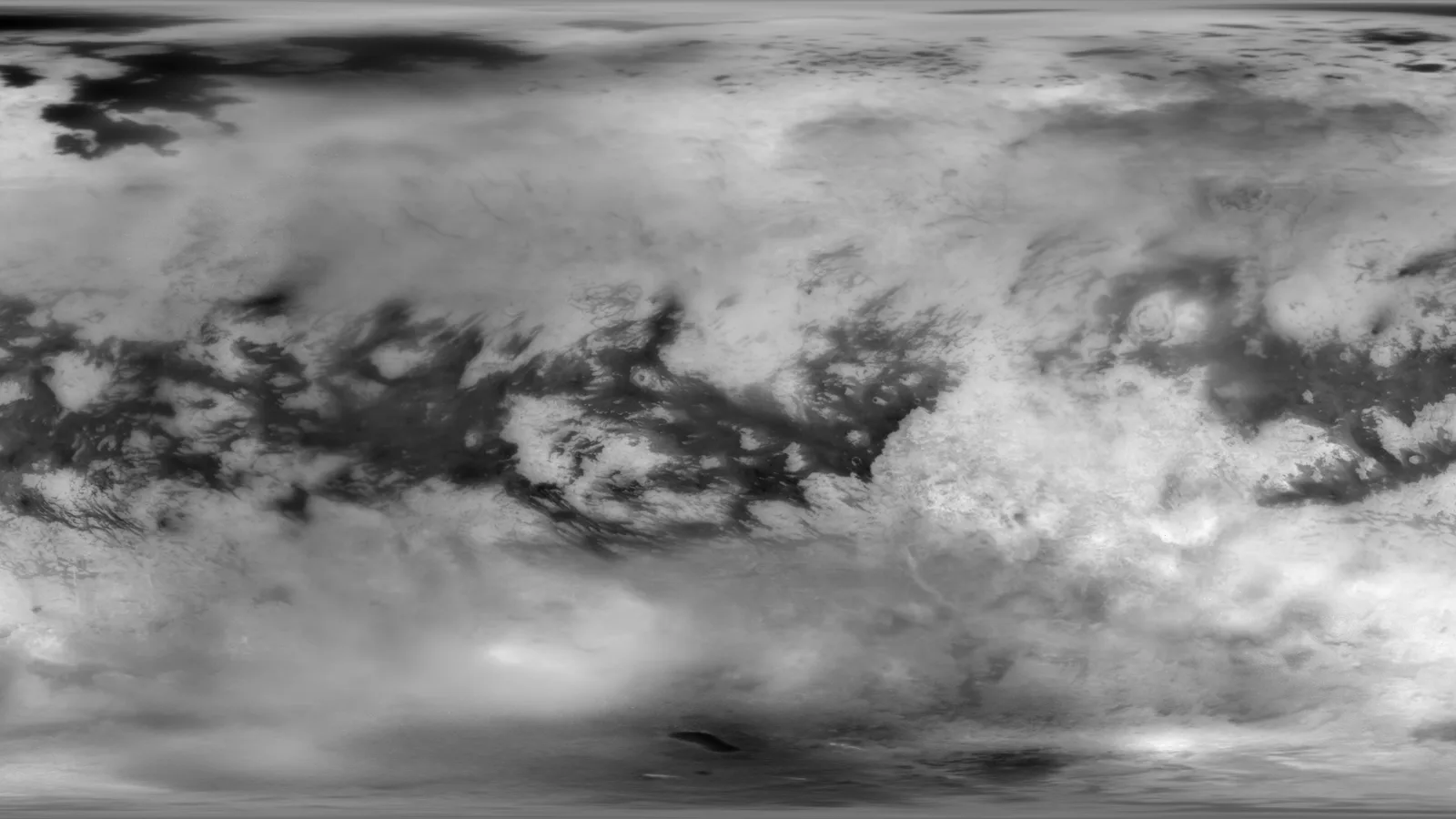
On 14 January 2005, Huygens came down through Titan's atmosphere and landed on a plain of water-ice pebbles. The ground had the consistency of wet sand. It returned more than 350 images during descent and kept working for 72 minutes on the surface.
In those pictures: an even orange sky. No stars. No solar disc. And no Saturn.
Saturn was overhead at that moment. From Titan its angular diameter is about 5.7 degrees — eleven times the Moon as seen from Earth. The ring system opens to roughly 13 degrees, close to 26 full moons laid side by side. Something that size, directly above, and the surface sees nothing of it.
Orange is not a sunset, it is haze
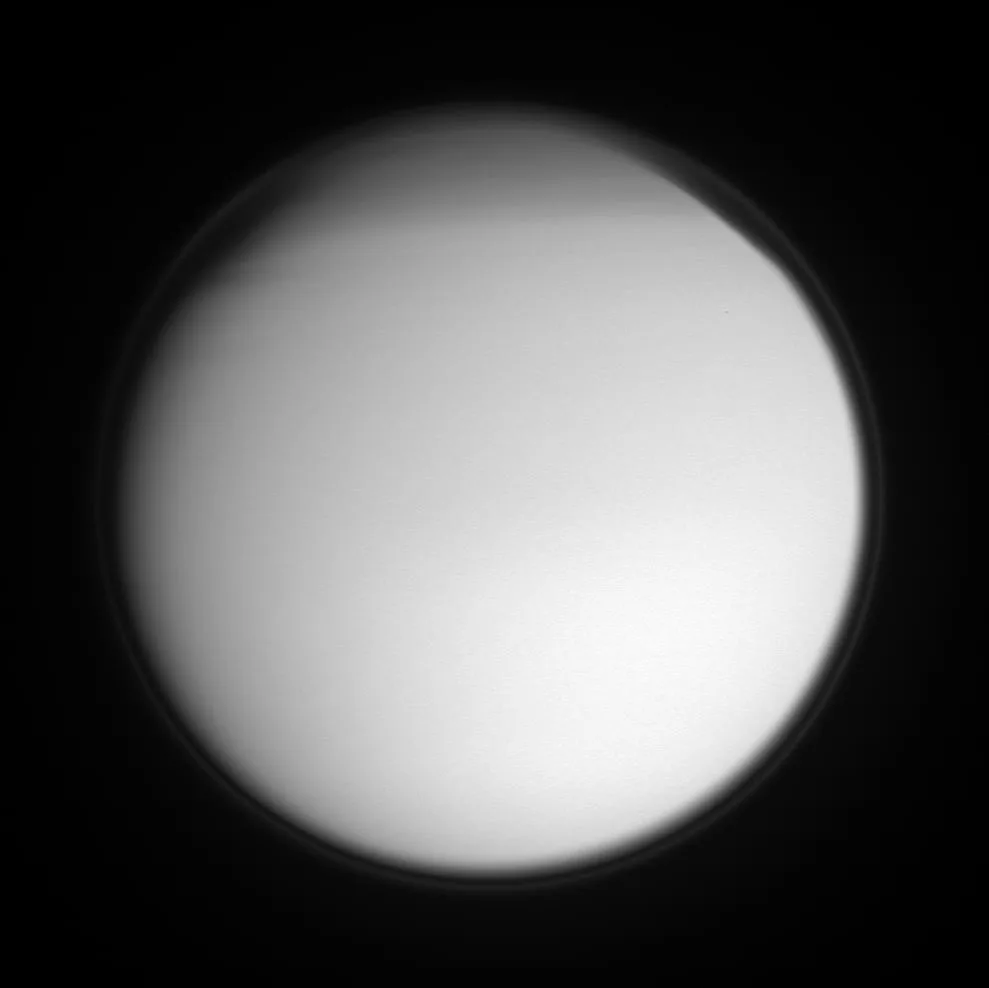
The obstruction is haze. Titan is the only moon in the solar system with a substantial atmosphere: 1.45 bar at the surface, above Earth's 1.013, composed of about 95% nitrogen and 5% methane. Ultraviolet light breaks methane and nitrogen apart in the upper atmosphere and the fragments reassemble into large organic molecules — tholins. Those particles are close to visible wavelengths in size, so they scatter and absorb blue light strongly and let red and yellow through. The sky is orange for the same structural reason as a dirty sunset, except it is permanent and it covers the whole moon.
Column mass is the part that matters. Titan's surface gravity is 1.35 m/s², about one seventh of Earth's, yet it holds 1.45 bar at ground level. The atmosphere is stacked far deeper than ours: scale height 40 to 50 km against Earth's 8 km, and roughly ten times Earth's atmospheric mass per unit area. Noon illuminance at the surface is about one thousandth of Earth's — the brightness of our sky just after the Sun has set. At that level the eye has nothing to work with. Saturn is there. The light arriving from it is not.
Why it can hold such a thick atmosphere
Why it can hold that much gas comes down to three conditions: enough mass, low enough temperature, high enough escape velocity. At 5,150 km across, Titan is larger than Mercury at 4,880 km and about 1.8 times the Moon's mass. Its density of 1.88 g/cm³ says more than half of it is water ice. At 94 K, nitrogen's thermal speed sits well below escape velocity, and methane's does too. The same methane at Earth temperatures would be gone quickly.
At 94 K, water behaves like rock. The crust is ice, with a liquid water ocean probably underneath. The volatile that evaporates, condenses, rains and runs in channels is methane.
A water cycle made of methane
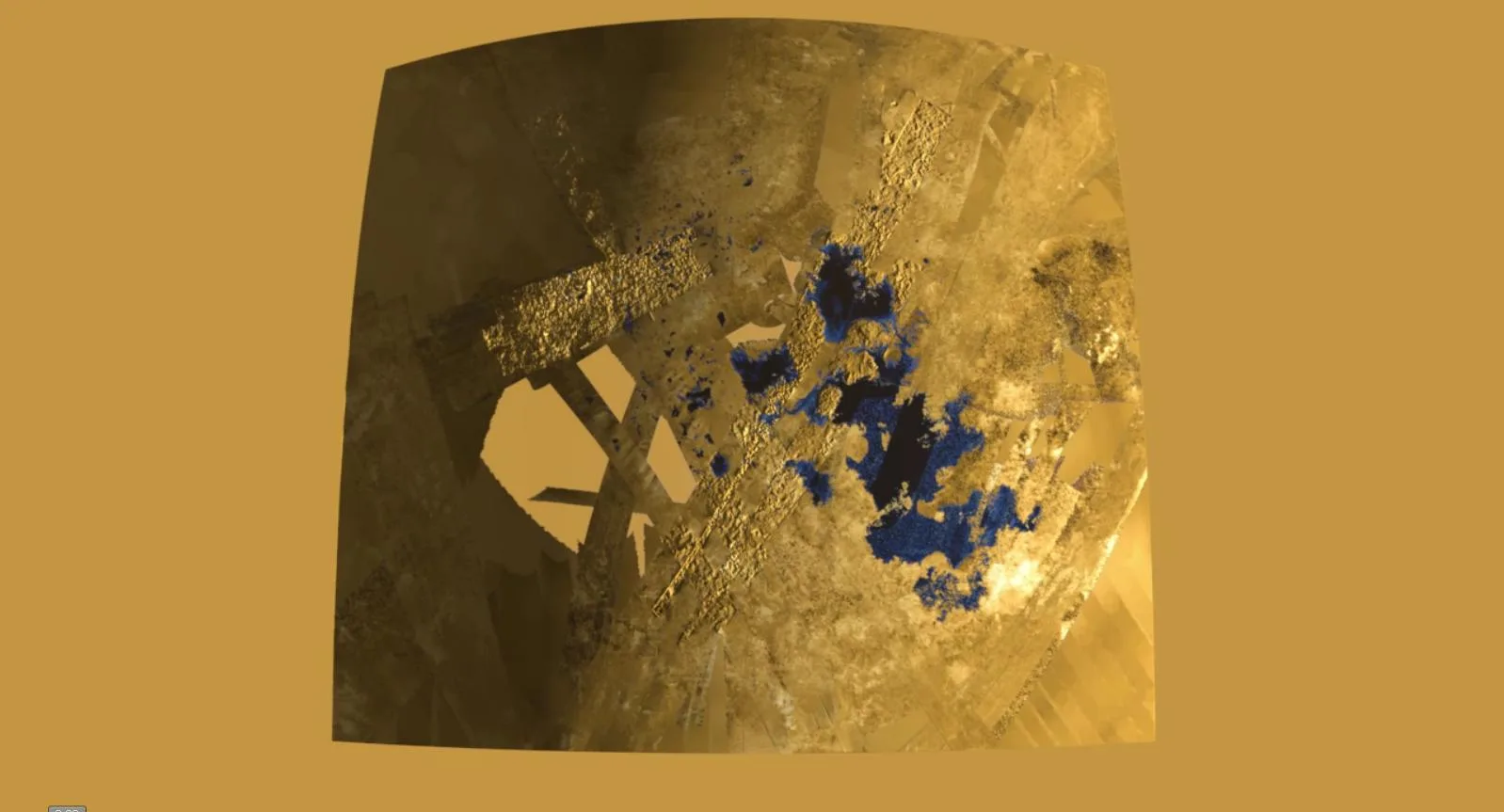
Cassini's radar found the lakes in 2006 — patches at high northern latitudes with almost zero reflectivity. Seas, channels, river mouths and deltas followed. Kraken Mare covers about 400,000 km², larger than the Caspian. The architecture is Earth's water cycle with a different working fluid. The equatorial dunes are not silicate sand either. The grains are water ice and organics, and the winds move them because near-surface density is about 4.5 times Earth's, so a few metres per second is sufficient.
Geometry: why Saturn barely moves
Then the geometry. Titan orbits at 1.22 million km with a period of 15.945 days and is tidally locked. From any fixed point on the surface, Saturn does not travel across the sky. It hangs, at nearly the same altitude, indefinitely. The 0.35-degree inclination and slight eccentricity add a small oscillation on the orbital period — legible across years, not across an evening.
One problem still open
One problem is still open. Photochemistry destroys methane on a timescale of tens of millions of years, and Titan still has 5% of it. Something is replenishing the supply: a subsurface reservoir, clathrate breakdown in the ice shell, surface chemistry. Cassini's data cannot separate those cases. Dragonfly is being built to sample several sites in the 2030s.
Putting the geometry in view
🪐 A note from building Solar Explorer 3D: Titan's close-up view is where the geometry becomes readable. Set time to 1 week per second and its 15.945-day orbit closes in a little over two seconds, with the moon and Saturn held in the same frame. Switch to the landing view, pick a site first, and the local sky shows which side Saturn sits on — the same question Huygens answered by returning an orange rectangle. The free tier covers the full solar-system scene, with close-up and landing views for the Sun, Mercury and Venus. The one-time premium unlock adds close-up, landing and time evolution for the 60+ bodies and spacecraft, in 10 languages. iPhone and iPad: https://apps.apple.com/app/id6752232739